
STRIKES™ Applied Coaching #003
Joshua Villalobos, PhD
Founder, Synergy Athletic Solutions
Same Activity, Different Experiences: Individual Responses to Opposed 1v1 Training in U8 Girls Soccer
Training is designed for the team but experienced by the individual player.
Introduction: From Training Design to Individual Experience
In STRIKES™ Applied Coaching 002, we examined how adjustments to training design influenced the distribution of opposed and unopposed activity during U8 girls recreational soccer training.
Opposed activity increased from 48.1% to 80.4% of identified activity time, demonstrating how changes in session design altered the training environment.
However, this raised another question:
When players participate in the same training activity, do they experience the same opportunities, challenges, and outcomes?
STRIKES™ Applied Coaching 003 investigates this question by examining individual player involvement and performance within a single opposed 1v1 training activity.
Our objective is not to rank players or identify talent. Rather, we aim to understand how individual players experience and respond to the challenges presented within a shared training environment.
Training Activity and Observational Methodology
On October 1, 2026, ten recreational U8 female soccer players participated in an 8-minute, 24-second opposed 1v1 activity.
Players attempted to penetrate two consecutive defensive zones while defenders attempted to prevent successful progression.
Using video-based observational coding, we documented four dimensions of individual experience:
- Attacking and defensive involvement frequency.
- Duration of attacking and defensive involvement.
- Successful attacking progression through Zone 1 and both zones.
- Recorded defensive stops.
Players were anonymized as A–J.
Attacking possessions were distinguished from zone-level involvements because one possession could involve actions in both zones. Attacking actions continuing after an invalid Zone 1 exit were not classified as successful two-zone completions.
These distinctions allowed us to examine individual exposure and observed task outcomes.
Results: Individual Experiences Within a Shared Activity
Figure 1. Individual Involvement Frequency
Across the activity, we recorded 69 zone-level player-role involvements: 35 attacking and 34 defending.
Individual players experienced between five and nine combined involvements.
Although all ten players participated in the same activity, they did not receive identical numbers of attacking and defensive opportunities.
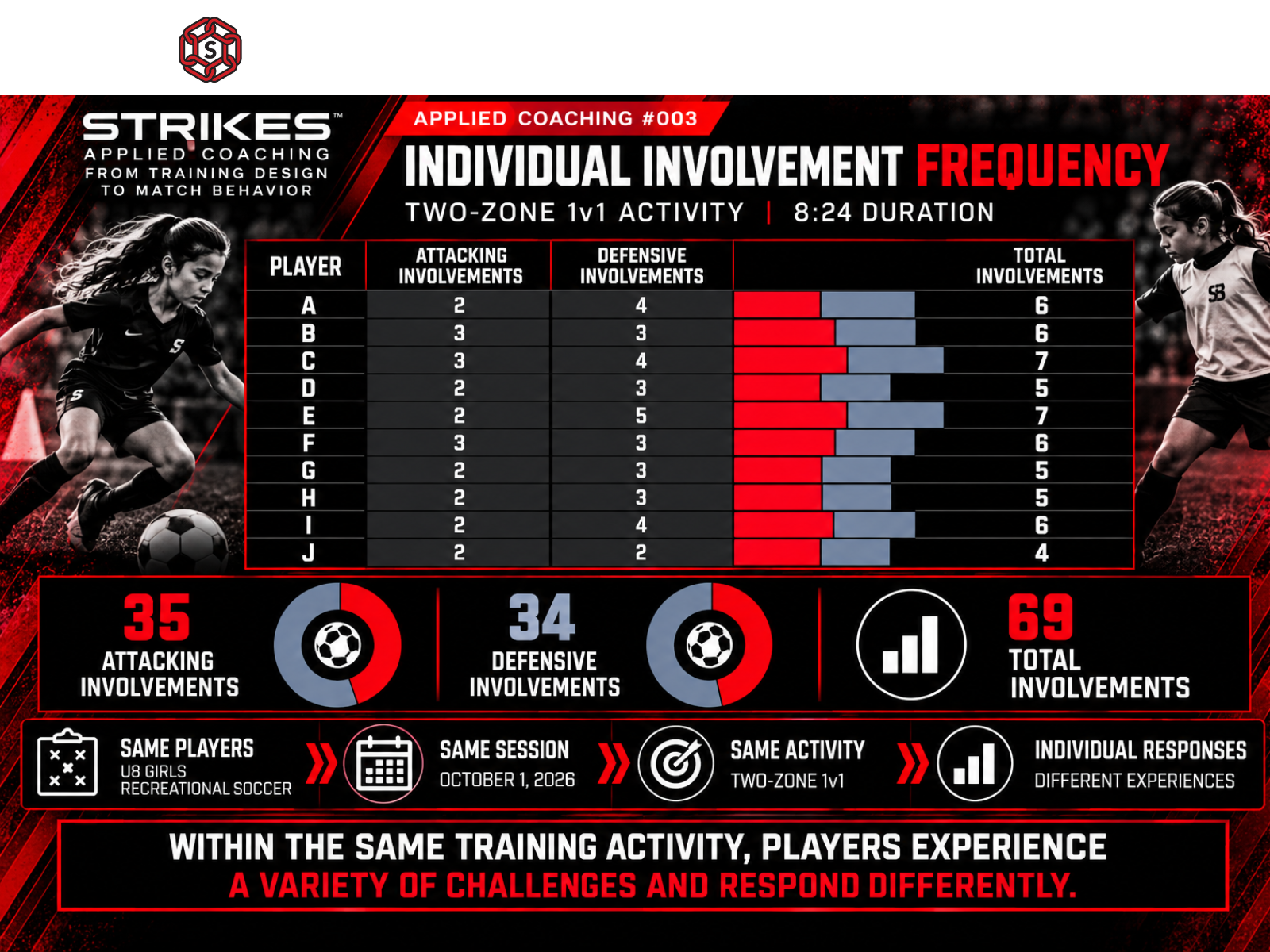
Figure 1. Individual attacking and defensive involvement frequency among ten U8 recreational female soccer players during an opposed 1v1 activity. Values represent coded zone-level player-role involvements.
Coaching implication: Team participation does not necessarily provide equivalent opportunities for individual players to encounter attacking and defensive challenges.
Figure 2. Individual Involvement Duration
We recorded 241 attacking role-seconds and 237 defending role-seconds, totaling 478 summed coded player-role seconds.
Individual combined involvement durations ranged from 24 to 68 seconds.
These measurements represent coded attacking and defending intervals rather than total physical activity or engagement time.
Figure 2. Individual attacking and defensive involvement duration. Values represent summed coded player-role seconds and should not be interpreted as total activity time.
Coaching implication: Players may experience different durations of exposure even when participating in the same training activity.
Figure 3. Individual Attacking Performance
Across 23 attacking possessions, nine (39.1%) resulted in successful Zone 1 penetration.
Only three possessions (13.0%) resulted in valid completion of the entire two-zone task.
Individual outcomes varied, including unsuccessful initial penetration, successful Zone 1 progression without full completion, and successful completion of both zones.
Figure 3. Individual attacking possession outcomes, distinguishing unsuccessful Zone 1 penetration, successful Zone 1 penetration without complete task success, and valid two-zone completion.
Coaching implication: Immediate attacking outcomes describe how players responded to the task but do not independently establish technical proficiency or learning.
Figure 4. Individual Defensive Performance
Across 34 defensive involvements, 22 (64.7%) were classified as successful defensive stops.
The remaining 12 did not result in a recorded stop.
Defensive stops included instances where defensive pressure caused an attacker to exit the designated area.
Figure 4. Individual defensive involvement outcomes, distinguishing recorded defensive stops from involvements without a recorded stop.
Coaching implication: Defensive outcomes varied between players, but successful stops alone do not fully explain the quality of individual defensive behavior.
Discussion: Training Is Experienced Individually
Collectively, these findings demonstrate that players participating in the same activity experienced different frequencies and durations of involvement, alongside different attacking and defensive outcomes.
Within the same training activity, players experience a variety of challenges and respond differently.
This distinction is important for coaches.
Training activities are commonly designed around team-level objectives. However, participation in the same activity does not guarantee equivalent individual exposure or identical performance outcomes.
The observations also highlight the distinction between exposure, performance, learning, and development.
Greater exposure does not necessarily indicate greater learning, and successful task completion does not independently establish developmental progress.
The present case study describes what individual players experienced and how they performed within one training activity.
Study Limitations
Several limitations should be considered when interpreting these findings.
Single-session observation. The analysis examined one 8-minute, 24-second activity involving ten recreational U8 female soccer players. Findings are descriptive and cannot be generalized to broader populations.
Coach-selected ability groupings. Players were grouped according to the coach’s previous observations of ability. Consequently, individual players may have encountered different levels of opposition, potentially influencing involvement frequency, duration, and task outcomes.
Limited individual observations. Players experienced relatively few attacking and defensive opportunities. Individual outcomes should not be interpreted as stable indicators of player ability.
Single-observer coding. The initial analysis was conducted by the coach. Inter-rater reliability was not established, and some outcomes required observational judgment.
Learning and development were not assessed. The analysis documented individual exposure and immediate performance outcomes. It cannot determine whether learning occurred or whether the activity produced lasting developmental changes.
Conclusion: From Team Design to Individual Experience
STRIKES™ Applied Coaching 002 examined how training design influenced the distribution of opposed and unopposed activity.
AC003 extends that investigation by examining individual player experiences within a shared opposed training activity.
The findings demonstrate that participation in the same exercise does not necessarily produce equivalent opportunities, durations of involvement, or performance outcomes.
For youth soccer coaches, the implication is not that every player must receive identical repetitions or achieve identical results.
Rather, coaches should recognize that individual experiences may vary within the same training environment.
Training is designed for the team but experienced by the individual player.
This investigation is part of STRIKES™ Applied Coaching, a research-informed approach to examining how soccer training environments are designed, experienced, measured, and evaluated.