
Creating the Problem Is Only the Beginning: From Training Design to Match Behavior in U8 Soccer
STRIKES™ Applied Coaching #002
Joshua Villalobos, PhD
Founder, Synergy Athletic Solutions
Training Sessions: September 17 and 24, 2026
Population: U8 Girls Recreational Soccer
Introduction: Teaching the Movement Is Only the Beginning
In STRIKES™ Applied Coaching #001, Teaching the Turn Is Not the Goal, I explored an important distinction in youth soccer development: teaching a player how to execute a movement is not necessarily the same as helping that player recognize when and why the movement may be useful.
The first training session progressed from movement and technical practice into opposed 1v1 situations and representative game play.
Although players demonstrated attempts to change direction, evade defenders, and attack available space, successful execution was inconsistent.
Some players struggled to maintain control of the ball. Others changed direction without accelerating into the space they had created. In several situations, opportunities to attack were available but went unrecognized.
These observations led to the next question:
If we create training environments that present more complex soccer problems, how will players respond, and will corresponding behaviors appear during competition?
This question became the focus of STRIKES™ Applied Coaching #002.
Rather than evaluating success through technical repetitions alone, the objective was to examine how training design influenced the types of problems players encountered and how they attempted to solve those problems.
How We Evaluated the Training
Our analysis examined video recordings from two consecutive training sessions and a subsequent competitive match.
Three questions guided the investigation:
1. How did the distribution of training activities change between AC001 and AC002?
2. How was training time organized to balance technical practice, opposed activity, recovery, and instruction?
3. Did players encounter and attempt to solve corresponding tactical problems during competition?
The analysis emphasized descriptive measurements, coaching observations, and practical significance.
It was not designed to establish statistical significance or demonstrate a causal relationship between a particular training activity and subsequent match performance.
Establishing the Correct Training Duration
An important methodological distinction was necessary for AC002.
Although the video recording lasted 65 minutes and 17 seconds, the first 4 minutes and 10 seconds involved pre-practice equipment setup.
The final 10 minutes and 13 seconds occurred after the player training session had ended and included a brief player meeting followed by coaching education discussions with fellow recreational coaches.
Both periods were excluded from the player training analysis.
The resulting AC002 training window was 50 minutes and 54 seconds, from 04:10 to 55:04.
This distinction ensures that the quantitative findings describe the actual player training period rather than the entire camera recording.
Finding 1: The Training Environment Changed
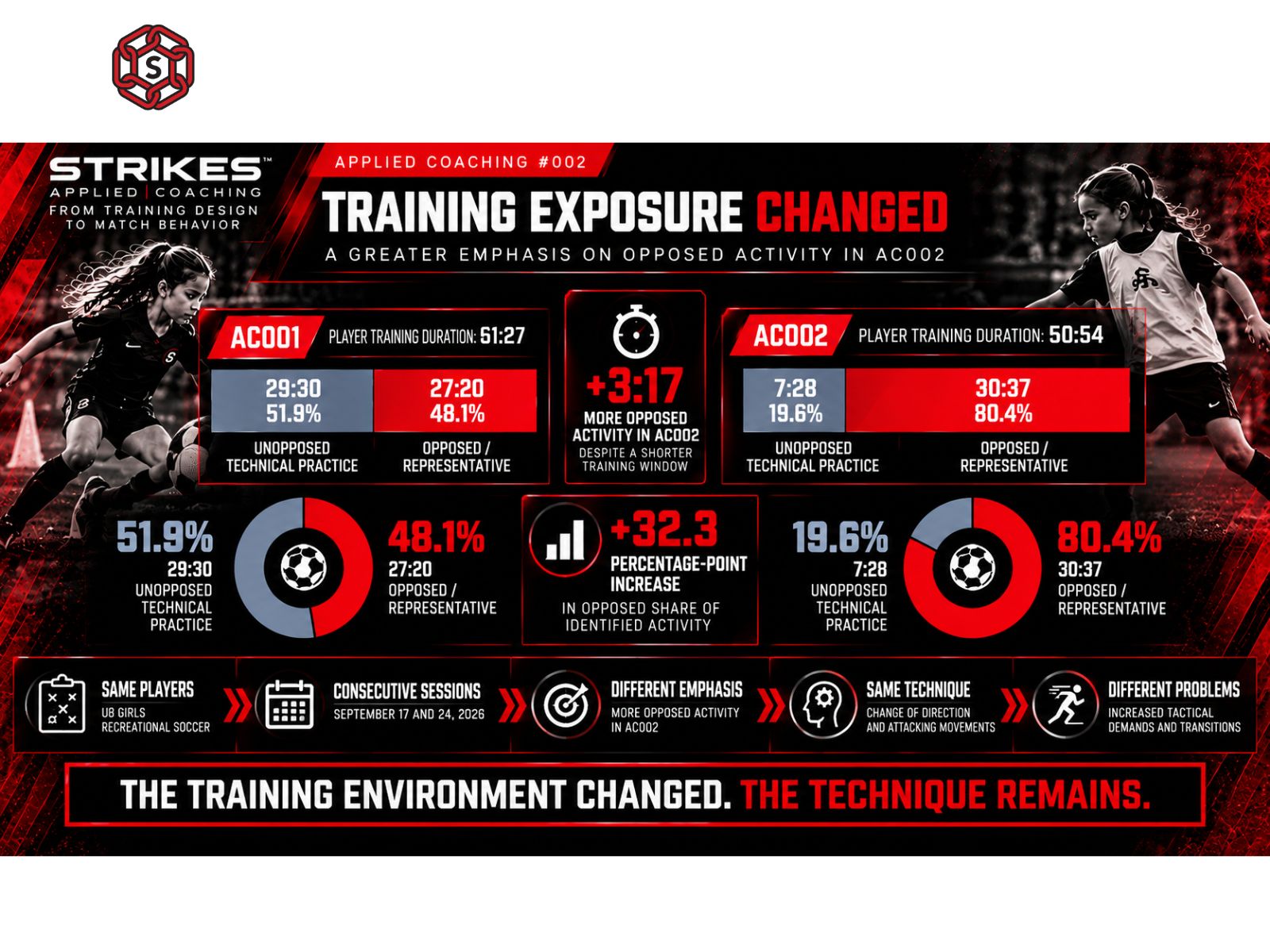
One of the clearest differences between AC001 and AC002 was the distribution of training time across unopposed and opposed activities.
AC001 included 29 minutes and 30 seconds of unopposed practice and 27 minutes and 20 seconds of opposed or game-based activity.
This represented a relatively balanced distribution of the 56 minutes and 50 seconds of identified activity time.
AC002 shifted toward greater opposed exposure.
Of the 38 minutes and 5 seconds of identified activity, 30 minutes and 37 seconds involved opposition, while 7 minutes and 28 seconds involved unopposed practice.
The proportion of classified activity involving opposition increased by 32.3 percentage points.
More importantly, AC002 included 3 minutes and 17 seconds more opposed activity, despite having a shorter overall training window.
These results demonstrate a meaningful change in training design.
However, the presence of opposition alone does not establish how representative an activity is of competition.
For example, AC002 included an opposed change-of-direction tag activity without a soccer ball. Although players responded to an opponent, the informational and technical demands differed from those encountered during an attacking 1v1 with the ball.
Similarly, unopposed technical activities may serve important developmental purposes.
The relevant question is not whether one category is universally better.
It is whether the training activity presents the information, decisions, and movement demands needed to support the intended learning objective.
Finding 2: Training Time Must Be Interpreted in Context
The distribution of activities provides useful information, but it does not tell the entire story.
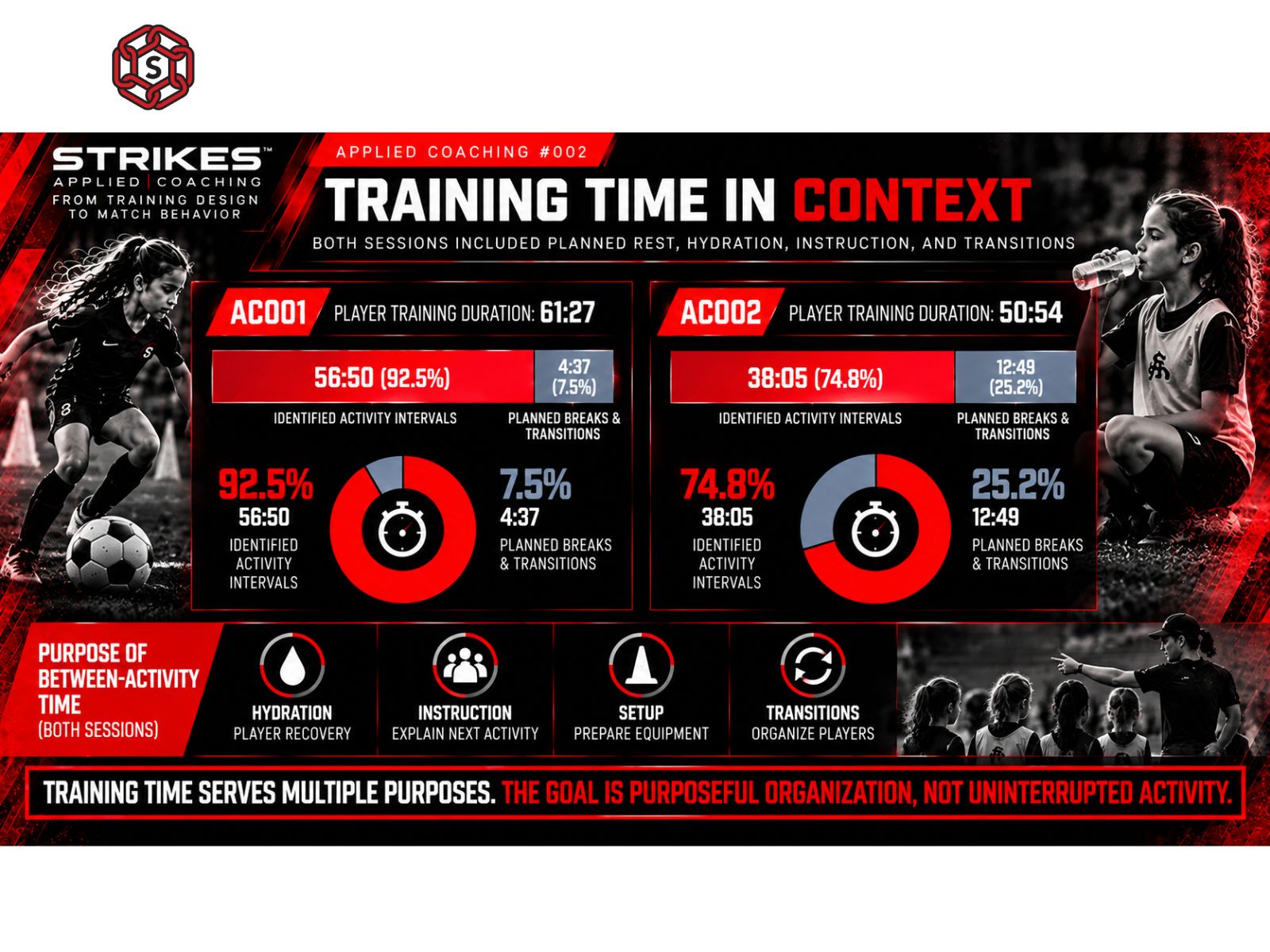
Both AC001 and AC002 included planned rest periods between activities.
These intervals allowed players to hydrate and recover while the coach prepared equipment, explained the next activity, and organized the subsequent learning environment.
In AC001, identified activity intervals accounted for 56 minutes and 50 seconds, or 92.5% of the recorded training session.
In AC002, identified activity intervals accounted for 38 minutes and 5 seconds, or 74.8% of the 50-minute, 54-second player training session.
How Training Time Was Organized
Both sessions intentionally incorporated recovery, hydration, instruction, and activity setup.
These periods should not be interpreted as unplanned inactivity or evidence of inefficient coaching.
Additionally, identified activity time is not equivalent to individual player engagement. Players may be waiting for repetitions or receiving feedback within an activity block.
The present analysis did not independently quantify each player’s physical activity, individual repetitions, or time spent receiving instruction.
Therefore, these findings describe session organization rather than individual engagement or training effectiveness.
For coaches, the practical consideration is how to balance meaningful participation, appropriate recovery, and preparation for subsequent learning challenges.
A well-designed training session does not necessarily require uninterrupted activity.
It requires purposeful organization that supports the intended developmental objectives.
Finding 3: The Problem Became More Complex
AC001 emphasized the progression from technical movement to opposed decision-making.
Initially, players practiced change-of-direction movements without direct opposition.
The primary question was:
How do I change direction while maintaining control of my body and the ball?
When a defender was introduced, the problem changed:
Can I use that movement to create space against an opponent?
AC002 extended this progression by incorporating more complex attacking and transitional situations.
From 1v1 Attacking to 1v2 Defending
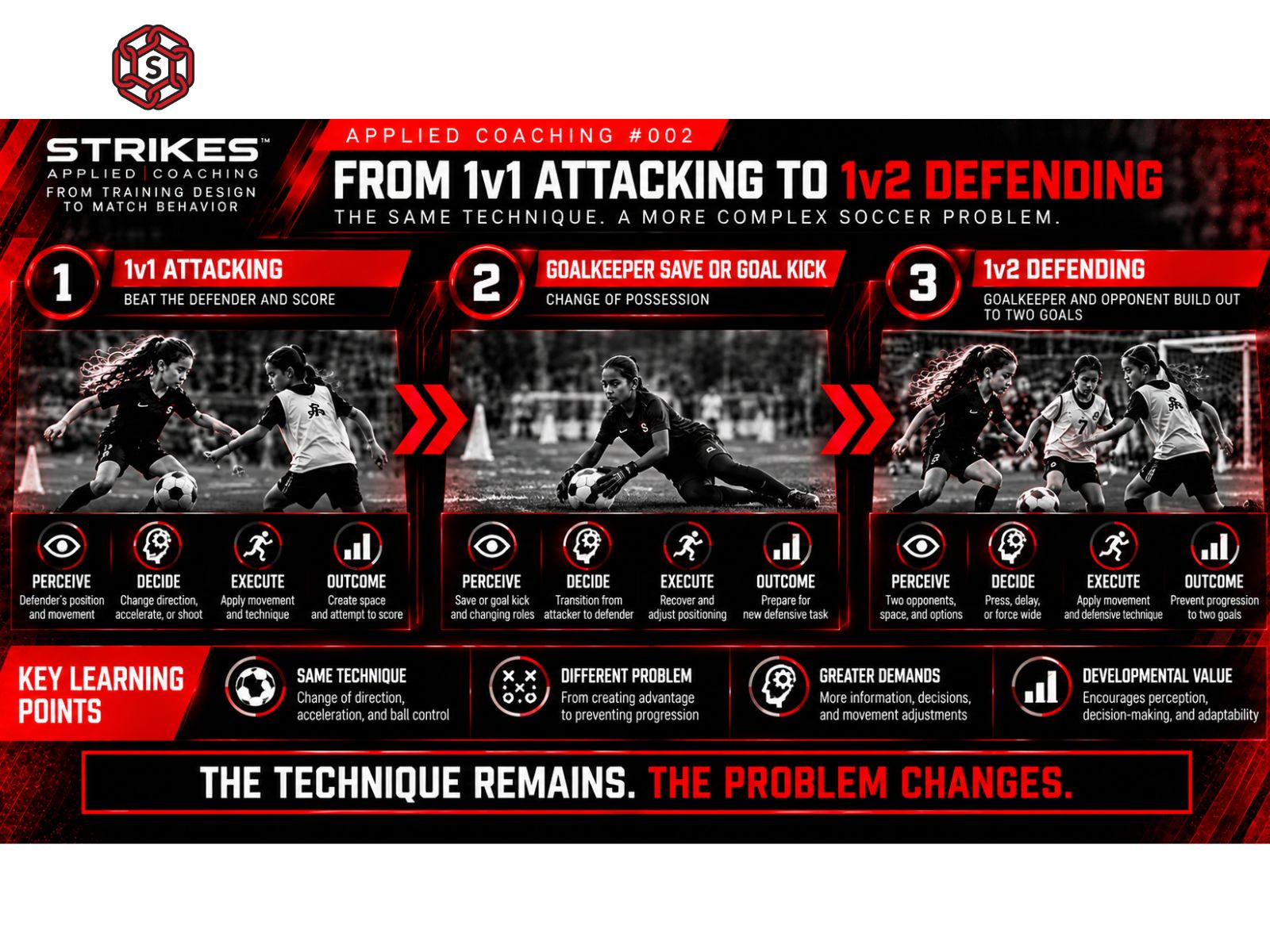
One AC002 activity began with an attacking player attempting to beat a defender and score against a goalkeeper.
Following a goalkeeper save or goal kick, the situation changed.
The original attacker became the lone defender, while the goalkeeper and former defender attempted to build out toward two counter goals.
The task therefore progressed from 1v1 attacking to 1v2 defending.
This introduced several interacting demands.
The attacking player initially needed to perceive the defender’s positioning, select an attacking solution, and execute the action.
Following the change in possession, the same player needed to recognize the transition, assume a defensive role, and respond to two opponents.
The movement techniques available to the player had not necessarily changed.
The information and tactical demands had.
This distinction is central to the applied coaching question.
A player may demonstrate the ability to perform a change-of-direction movement in isolation yet struggle to recognize when it is appropriate during competition.
Likewise, a player may recognize a tactical opportunity but lack the technical capacity to execute the selected action successfully.
Training design should therefore consider both the physical and technical capacities of the player and the perceptual and decision-making demands of the environment.
The technique remains. The problem changes.
Finding 4: Did Corresponding Behaviors Appear During Competition?
The subsequent competitive match provided an opportunity to observe how players responded to situations resembling those introduced during training.
The coach-annotated match log identified 29 selected moments involving attacking actions, changes of direction, restarts, and goalkeeper build-outs.
Fourteen were identified as candidate goalkeeper/build-out situations.
These observations were selected for analysis rather than collected as a complete record of every eligible match event.
Consequently, they cannot be used to calculate match-wide success rates or establish the frequency of particular behaviors.
Nevertheless, the selected moments provide useful examples for examining the relationship between training problems and match situations.
Attacking Space and 1v1 Situations
Several match situations presented opportunities for players to attack defenders or advance into available space.
Player responses varied.
In some situations, players recognized space and attempted to dribble forward.
In others, players delayed their actions, selected alternative solutions, or failed to exploit the available opportunity.
Technical execution also varied.
An appropriate attacking decision did not always result in a successful outcome.
This distinction matters.
A player who recognizes an opportunity to accelerate beyond a defender but loses possession may have demonstrated a different developmental need from a player who never recognizes the opportunity.
Both situations may produce an unsuccessful outcome, but the underlying challenges are not necessarily the same.
Goalkeeper Build-Outs
The match also presented situations in which players needed to progress possession from the goalkeeper.
These moments introduced questions involving positioning, available space, passing options, and decisions to dribble or distribute the ball.
The observed responses were inconsistent.
Some situations produced attempts to advance possession, while others involved hesitation, delayed restarts, or unsuccessful execution.
These observations suggest that similar tactical problems appeared in both the training environment and competition.
However, similarity between training and match situations does not establish that the training caused the observed behaviors.
The players’ responses may reflect prior experiences, existing abilities, contextual factors, or learning occurring across multiple sessions.
The observations provide a basis for further investigation rather than a definitive conclusion about training transfer.
Finding 5: Evaluate the Problem, Not Just the Outcome
One limitation of evaluating young players solely through successful or unsuccessful actions is that different developmental challenges can produce the same outcome.
Consider two players who lose possession during an attacking 1v1.
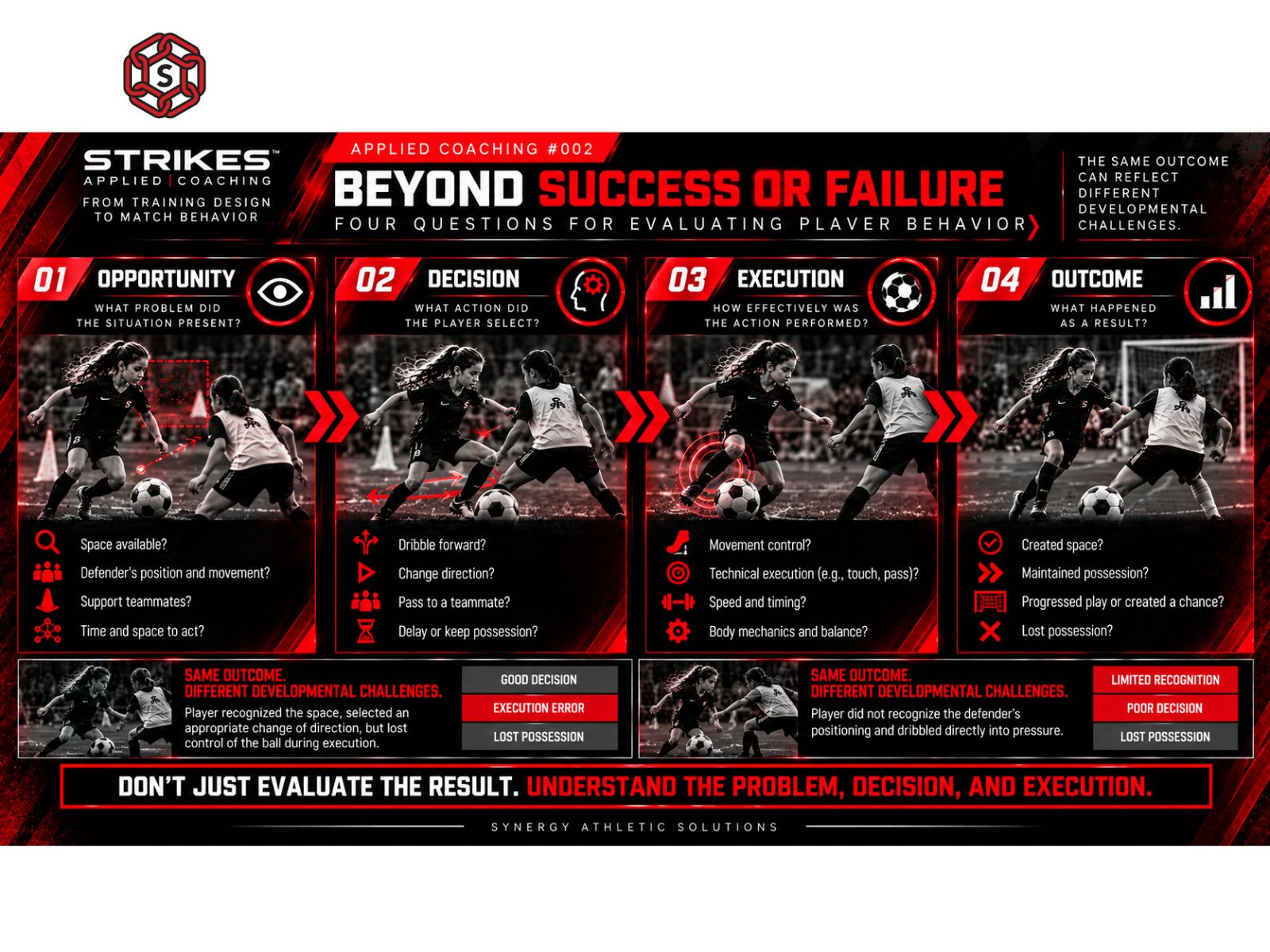
The first recognizes space, selects an appropriate change of direction, but loses control of the ball during execution.
The second fails to recognize the defender’s positioning and dribbles directly into pressure.
Both players lose possession.
However, their actions suggest different challenges.
The first may benefit from improving technical control under pressure.
The second may benefit from training environments that provide opportunities to recognize and respond to defensive information.
These interpretations remain coaching hypotheses until examined through additional observations.
A Practical Framework for Evaluating Player Behavior
Four questions can help organize the analysis:
1. Opportunity — What problem was available?
What space, opponent movement, or tactical situation presented an opportunity for action?
2. Decision — What solution did the player attempt?
Did the player dribble, pass, change direction, accelerate, delay, or select another response?
3. Execution — How effectively was the action performed?
Did the player demonstrate sufficient movement control and technical ability to carry out the intended action?
4. Outcome — What happened next?
Did the action create space, maintain possession, progress play, or produce another result?
These questions encourage coaches to examine the relationship between information, decisions, execution, and outcomes.
The objective is not to assign a definitive explanation to every unsuccessful action.
It is to develop better questions that can inform future training design.
Finding 6: Playing Continuity Deserves Further Investigation
The match observations also included interruptions to play, delayed restarts, and situations in which opportunities to resume play were not immediately recognized.
These moments raise additional questions about the learning environment.
How frequently are players presented with meaningful soccer problems during competition?
How much time is spent with the ball in play?
How quickly do players recognize opportunities following restarts or changes in possession?
The current analysis did not independently quantify total ball-in-play time or average restart duration.
Therefore, conclusions about playing continuity remain preliminary.
Nevertheless, these questions may provide useful directions for future analysis.
What Comes Next?
The next phase of STRIKES™ Applied Coaching will examine individual player responses across multiple training sessions and competitive matches.
The objective will be to investigate whether players begin to recognize similar tactical opportunities more consistently, how their decisions evolve, and whether their technical execution changes over time.
This is particularly important in youth soccer because players do not necessarily develop at the same rate.
A training environment may present the same problem to several players, yet each may interpret and respond to it differently.
By examining individual developmental trajectories, we can begin to identify whether modifications to the training environment correspond with meaningful changes in player behavior.
The emphasis will remain on practical significance and the systematic evaluation of coaching decisions.
Applied Coaching Takeaway: Creating the Problem Is Only the Beginning
Across AC001 and AC002, the training environment progressed from technical movement practice toward increasingly complex opposed and tactical situations.
AC002 devoted a greater proportion of its identified activity time to opposition and introduced transitions requiring players to respond to changing roles and numerical relationships.
The subsequent match presented several corresponding tactical problems, including attacking space, 1v1 situations, and goalkeeper build-outs.
Player responses remained inconsistent.
These observations do not demonstrate that one session was more effective or that training caused subsequent match behaviors.
They do illustrate why evaluating training requires more than counting repetitions, measuring activity duration, or observing whether a player succeeds.
The central question is whether the training environment presents meaningful problems and whether our observations help us understand how players respond.
For coaches, the process remains:
Design the environment. Measure what happened. Observe player behavior. Interpret the findings. Adapt the approach. Reassess.
Creating the problem is only the beginning.
Understanding the player’s response is where the next coaching decision begins.
STRIKES™ Applied Coaching is a systematic, research-informed examination of training design and player behavior. Its purpose is to document coaching practice, encourage critical evaluation, and explore the practical significance of observed developmental responses.
Methodological note: The AC002 analysis excludes 4:10 of pre-practice setup and 10:13 of post-practice activities. Training exposure percentages are based on identified activity intervals. Both sessions incorporated planned rest, hydration, instruction, and setup periods. Individual player engagement and match-wide behavioral success rates were not independently quantified.
Data note:
AC001 vs. AC002: Training Duration
| Measure | AC001 | AC002 |
|---|---|---|
| Player training duration | 61:27 | 50:54 |
| Identified activity intervals | 56:50 | 38:05 |
| Activity-block coverage | 92.5% | 74.8% |
| Between-activity time | 4:37 | 12:49 |
AC001 vs. AC002: Training Exposure
| Measure | AC001 | AC002 |
|---|---|---|
| Player training duration | 61:27 | 50:54 |
| Identified activity time | 56:50 | 38:05 |
| Unopposed activity | 29:30 | 7:28 |
| Opposed activity | 27:20 | 30:37 |
| Unopposed share of identified activity | 51.9% | 19.6% |
| Opposed share of identified activity | 48.1% | 80.4% |
Explore More STRIKES™ Applied Sport Science
Synergy Athletic Solutions Applied Sport Science in Soccer — YouTube
© 2026 Synergy Athletic Solutions — STRIKES™ Applied Coaching