
Does the Same Soccer Training Produce the Same Demands for Every Player? | STRIKES™ Applied Sport Science
By Dr. Joshua Villalobos, PhD
Founder, Synergy Athletic Solutions
STRIKES™ Applied Sport Science
When coaches design a soccer training session, the session is typically prescribed to the team.
Players complete the same training plan, participate in many of the same activities, and train within the same overall environment.
It is therefore tempting to assume that the session represents a relatively consistent training stimulus across the team.
But does it?
My research suggests the answer is more complicated.
The demands experienced during soccer training can differ according to tactical position, competition level, and the specific training session.
More importantly, these factors can interact.
That means players participating within the same overall training structure may experience different physical and physiological demands.
The session is prescribed to the team. The stimulus is experienced by the player.
From Identifying Talent to Understanding Development
Throughout this STRIKES™ research series, we have progressively challenged the idea that soccer development can be understood through simple labels.
Relative age can shape developmental opportunity.
Biological maturation can influence the physical characteristics coaches observe.
Talent identification and selection occur within a complex and uncertain developmental process.
And in the previous STRIKES™ analysis, Advanced players were not simply better across every physical quality.
Instead, the differences were multidimensional.
That finding leads naturally to another question:
What happens when different players enter the same training environment?
If players enter training with different physical capacities, tactical roles, competitive experiences, and developmental histories, should we expect the same training structure to produce the same demands?
This question is particularly relevant in soccer because coaches routinely use game-based training to simultaneously develop physical, technical, and tactical qualities.
Small-sided games are widely used because they can reproduce important movement and physiological characteristics of soccer while requiring players to execute skills and make decisions under pressure (Gabbett & Mulvey, 2008; Hill-Haas et al., 2011).
But a common activity does not guarantee a common training response.
That distinction forms the foundation of this analysis.
The Study
The data presented in this article come from my original research involving 47 female soccer players between 14 and 17 years of age, classified as either Advanced (n = 27) or Competitive (n = 20).
Players participated in standardized soccer training sessions while physical and physiological demands were monitored.
The primary measures examined here included Total Distance, High-Intensity Running, Muscle Load, and Cardio Load.
Rather than examining only average differences between competition levels, the analysis also considered tactical position and training session.
This allows us to move beyond a relatively simple question:
Did Advanced and Competitive players experience different training loads?
And toward a more applied one:
Did those differences depend on tactical position and the session being performed?
The first layer is position.
Position Changes the Training Profile
A team participates in one training session.
But a forward, midfielder, and defender do not necessarily experience that session in the same way.
Previous research in women’s soccer provides important context.
Mohr et al. (2008) demonstrated that match demands differed according to both performance level and tactical position. Mara et al. (2016) similarly showed that changing game format altered the physical and physiological demands of training in elite female players.
The training environment is therefore unlikely to produce one uniform physical profile across every tactical role.
Figure 1. Team Load ≠ Player Load
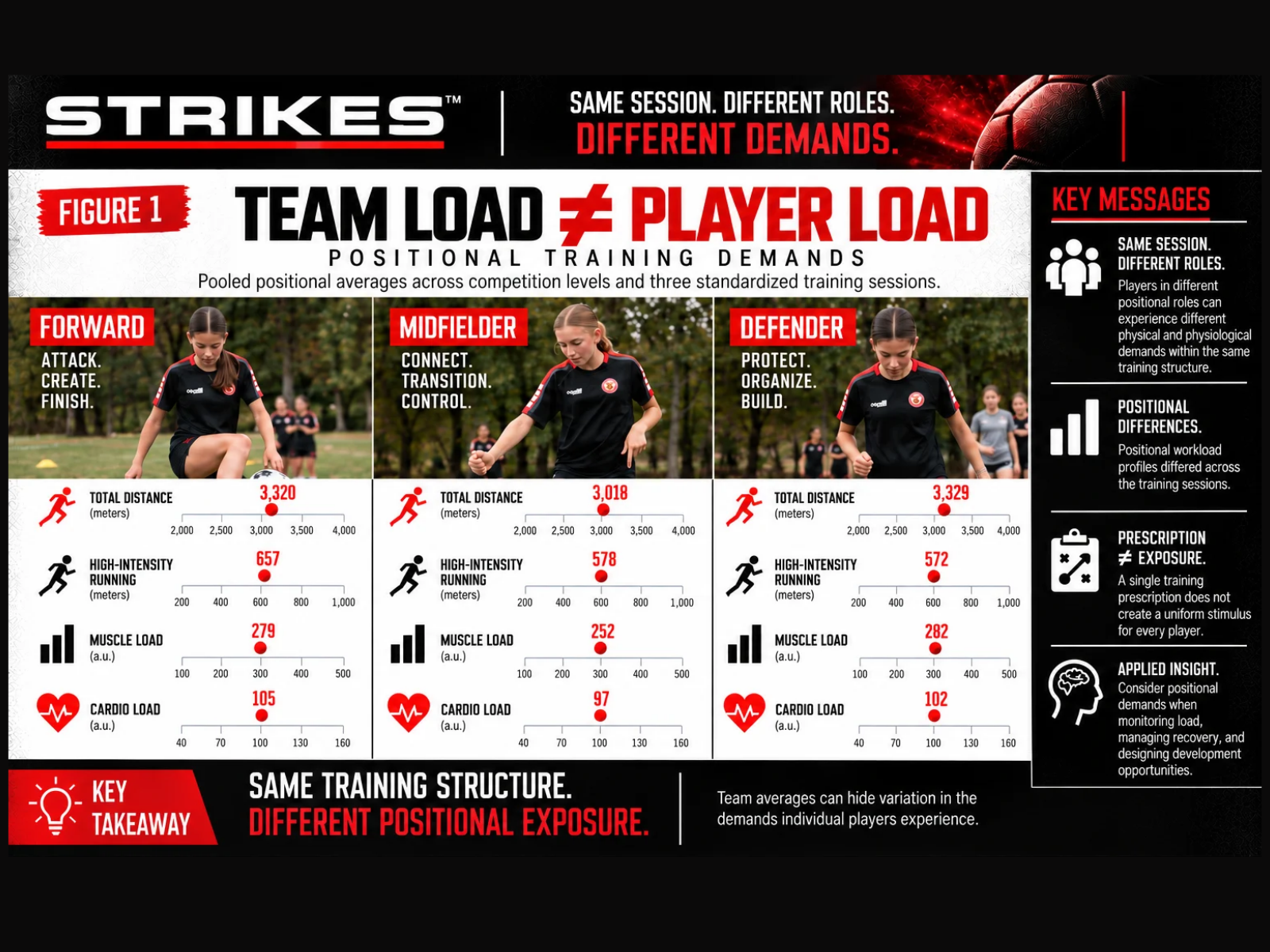
Figure 1. Pooled positional training demands for forwards, midfielders, and defenders across three standardized soccer training sessions. Team-level averages can conceal variation in the demands experienced by different positional roles.
When data were pooled across competition levels and the three standardized training sessions, different positional workload profiles emerged.
Forwards accumulated approximately 3,320 m of Total Distance, compared with 3,018 m for midfielders and 3,329 m for defenders.
High-Intensity Running also differed descriptively:
Forwards: 657 m
Midfielders: 578 m
Defenders: 572 m
Muscle Load demonstrated another pattern:
Forwards: 279 a.u.
Midfielders: 252 a.u.
Defenders: 282 a.u.
Cardio Load was comparatively similar:
Forwards: 105 a.u.
Midfielders: 97 a.u.
Defenders: 102 a.u.
The purpose of these descriptive values is not to declare one position universally more demanding than another.
The more important observation is that the workload profile differed across positional roles.
A position associated with greater exposure in one variable did not necessarily demonstrate the greatest value in another.
POSITION → TRAINING EXPOSURE
The same overall training structure can contain different positional exposures.
But position alone does not explain the entire response.
Competition Level Adds Another Layer
Next, we can separate those positional profiles according to competition level.
Previous research suggests that standard of play can be associated with the demands players experience during soccer activity.
Dellal et al. (2011) identified differences in physiological, physical, and technical responses between amateur and professional players during small-sided games. In women’s soccer, Mohr et al. (2008) also reported greater high-intensity running and sprinting among players competing at a higher performance level.
These findings provide useful context for the Advanced-versus-Competitive comparison in the present data.
Figure 2. Does Competition Level Change Positional Training Demands?
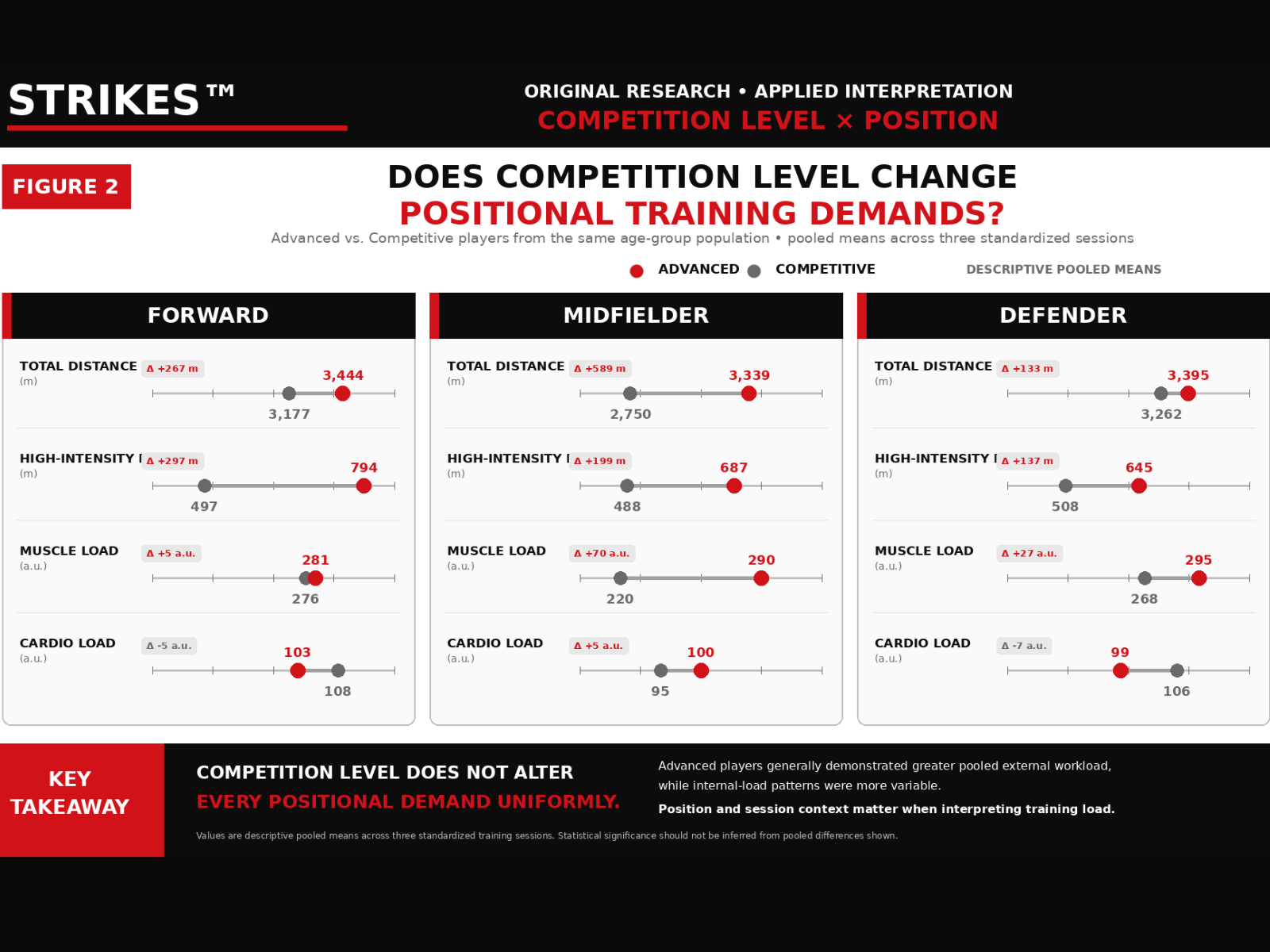
Figure 2. Descriptive pooled training-load means for Advanced and Competitive soccer players by tactical position across three standardized training sessions. Competition level did not alter every positional demand uniformly.
Among forwards, Advanced players accumulated approximately 3,444 m of Total Distance, compared with 3,177 m among Competitive players.
High-Intensity Running was:
Advanced: 794 m
Competitive: 497 m
Pooled Muscle Load was much closer:
Advanced: 281 a.u.
Competitive: 276 a.u.
Cardio Load moved slightly in the opposite direction:
Advanced: 103 a.u.
Competitive: 108 a.u.
The midfielder profile was different.
Advanced midfielders accumulated approximately 3,339 m of Total Distance, compared with 2,750 m for Competitive midfielders.
High-Intensity Running was:
Advanced: 687 m
Competitive: 488 m
Muscle Load was:
Advanced: 290 a.u.
Competitive: 220 a.u.
Defenders demonstrated another profile.
Advanced defenders accumulated approximately 3,395 m of Total Distance, compared with 3,262 m among Competitive defenders.
High-Intensity Running was:
Advanced: 645 m
Competitive: 508 m
Muscle Load was approximately 295 versus 268 a.u., while Cardio Load was 99 versus 106 a.u.
These values are descriptive pooled means.
The differences displayed in Figure 2 should therefore not independently be interpreted as tests of statistical significance.
Instead, the figure illustrates something more important:
Training exposure can differ according to competition level, but those differences are not uniform across every position or every variable.
This adds another layer:
COMPETITION LEVEL × POSITION → TRAINING EXPOSURE
But pooled averages create another problem:
They can describe the group accurately while concealing what happened within individual positions and sessions.
The Average Can Hide the Interaction
Consider Muscle Load.
When mean Muscle Load was compared between competition levels across all three training sessions, there was no overall competition-level effect:
p = .586
Viewed only through that average, we might reasonably conclude that Advanced and Competitive players experienced relatively similar Muscle Load.
But the repeated-measures analysis revealed something the pooled average concealed.
There was a significant:
Time × Competition Level × Tactical Position Interaction
F(3.84, 376) = 2.86, p = .03
In other words, the difference between Advanced and Competitive players depended on both tactical position and training session.
This is consistent with broader soccer research showing that training responses can change when characteristics of the environment change.
Rampinini et al. (2007) demonstrated that physiological responses during small-sided games could be altered through characteristics such as game format, playing area, and coach encouragement. Lacome et al. (2018) went a step further by questioning whether a single small-sided-game format provides an equivalent stimulus across all players.
The present findings add a different layer:
Competition level, tactical position, and session context can interact within the same overall training environment.
Figure 3. The Average Hides the Interaction
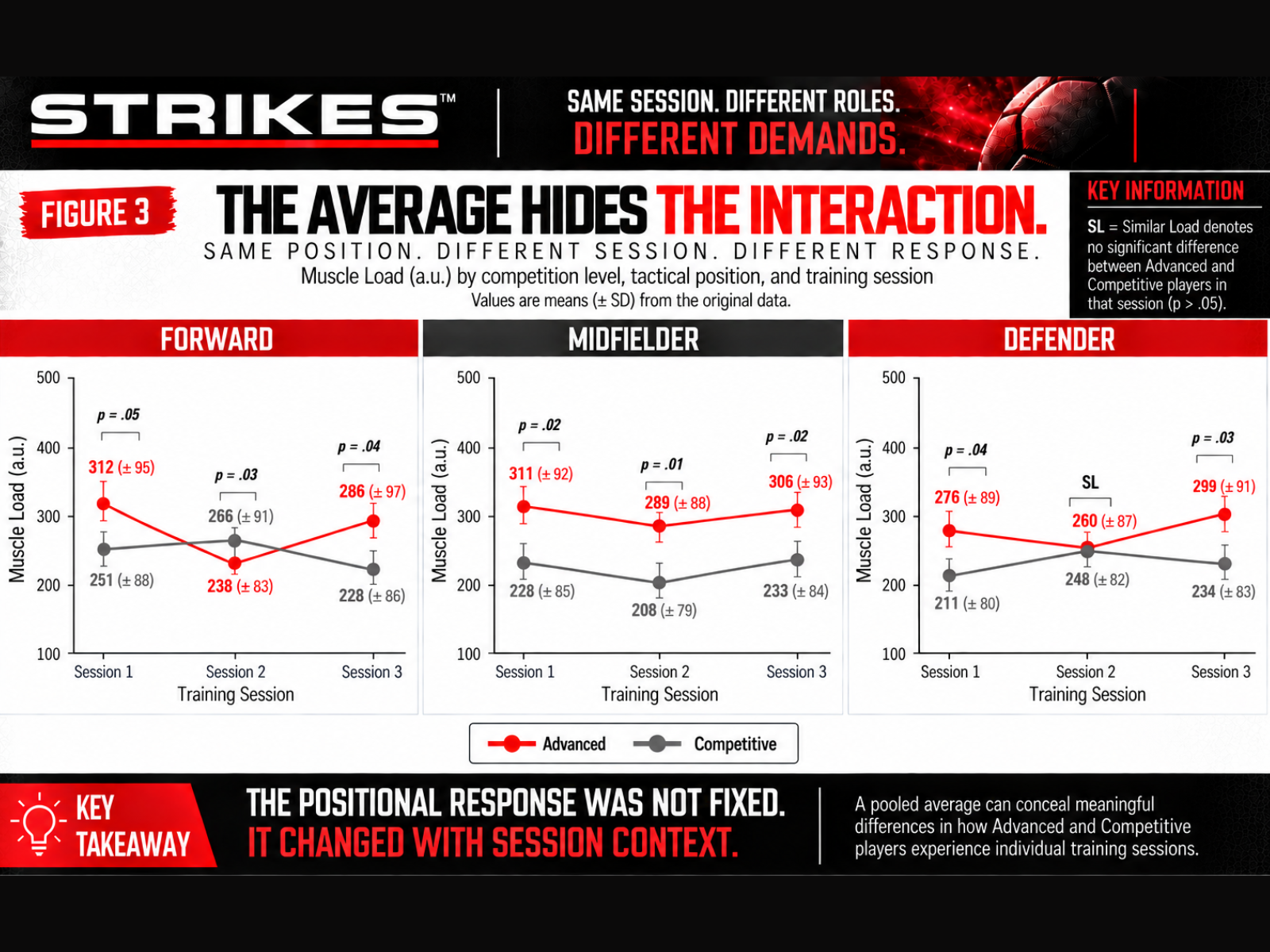
Figure 3. Muscle Load responses for Advanced and Competitive soccer players by tactical position across three standardized training sessions. SL denotes similar load, indicating no statistically significant difference between competition levels within that session.
Forwards: The Relationship Reversed
The forward data provide a particularly clear example.
During Session 1, Advanced forwards demonstrated significantly greater Muscle Load than Competitive forwards:
p = .05
During Session 2, the relationship reversed.
Competitive forwards demonstrated significantly greater Muscle Load:
p = .03
Then during Session 3, Advanced forwards again demonstrated significantly greater Muscle Load:
p < .05
Same position.
Same competition-level comparison.
Different session. Different relationship.
Midfielders: A Different Pattern
Advanced midfielders demonstrated significantly greater Muscle Load across all three training sessions:
Session 1: p = .01
Session 2: p = .02
Session 3: p = .04
Unlike the forwards, the direction of the competition-level difference remained consistent.
The defenders demonstrated another pattern again.
Defenders: Session Context Matters Again
Advanced defenders demonstrated significantly greater Muscle Load during:
Session 1: p = .01
and
Session 3: p = .04
During Session 2, however, there was no statistically significant difference:
p = .18
In Figure 3, this is identified as:
SL = Similar Load
The positional response was therefore not fixed.
It changed with session context.
This produces the most important layer of the analysis:
COMPETITION LEVEL × POSITION × SESSION CONTEXT → TRAINING RESPONSE
One Average Can Contain Multiple Stories
This is precisely why averages need to be interpreted carefully.
The overall Muscle Load comparison suggested no competition-level difference.
Underneath that average, however, were several different responses.
Advanced midfielders demonstrated greater Muscle Load across all three sessions.
Advanced defenders demonstrated greater Muscle Load during Sessions 1 and 3, but not Session 2.
And among forwards, the direction of the difference actually reversed during Session 2.
All of these responses contribute to the overall average.
The average was not wrong. It was incomplete.
Team and group averages remain useful for summarizing training.
But they answer one particular question:
“What happened to the group overall?”
Player development may require another:
“What happened to this player within this training environment?”
Those questions are related.
They are not interchangeable.
The Pattern Extends Beyond Muscle Load
Muscle Load provides the clearest illustration, but it was not the only variable in which training response depended on context.
For Total Distance, the overall comparison across the three sessions showed no competition-level effect:
p = .167
Yet the repeated-measures analysis identified a significant time × competition level × tactical position interaction.
Advanced forwards accumulated significantly greater Total Distance during Sessions 1 and 3 but significantly less during Session 2.
Advanced midfielders accumulated significantly greater Total Distance during Sessions 1 and 2, while no difference was observed during Session 3.
Defenders showed no significant competition-level differences across the three sessions.
High-Intensity Running revealed a somewhat different pattern.
Advanced players accumulated significantly greater High-Intensity Running overall.
They also accumulated significantly greater High-Intensity Running during Sessions 1 and 3.
During Session 2, however, there was no significant competition-level difference.
Importantly, the time × competition level × tactical position interaction was not significant for High-Intensity Running.
That distinction matters.
Not every training-load variable followed the same pattern.
And we should not force every variable into the same interpretation.
External Work and Internal Response Tell Different Parts of the Story
Cardio Load reinforces this point.
Across all three sessions, there was no overall competition-level effect for Cardio Load:
p = .702
Yet the repeated-measures analysis identified a significant interaction involving time, competition level, and tactical position.
Advanced forwards demonstrated significantly lower Cardio Load during Session 2.
Advanced midfielders demonstrated significantly lower Cardio Load during Sessions 1 and 3.
Advanced defenders demonstrated significantly lower Cardio Load during Session 1.
Considered alongside Total Distance, High-Intensity Running, and Muscle Load, these findings demonstrate why a single metric cannot completely describe the training experience.
External workload tells us something about the work performed.
Internal load tells us something about the physiological response associated with that work.
That brings us back to an important question from the STRIKES™ research series:
What did the athlete accomplish—and what did it cost?
Both sides of that question matter.
From Training Prescription to Training Response
Taken together, these findings inform a broader STRIKES™ applied conceptual framework for thinking about how a team training prescription becomes an individual training response.
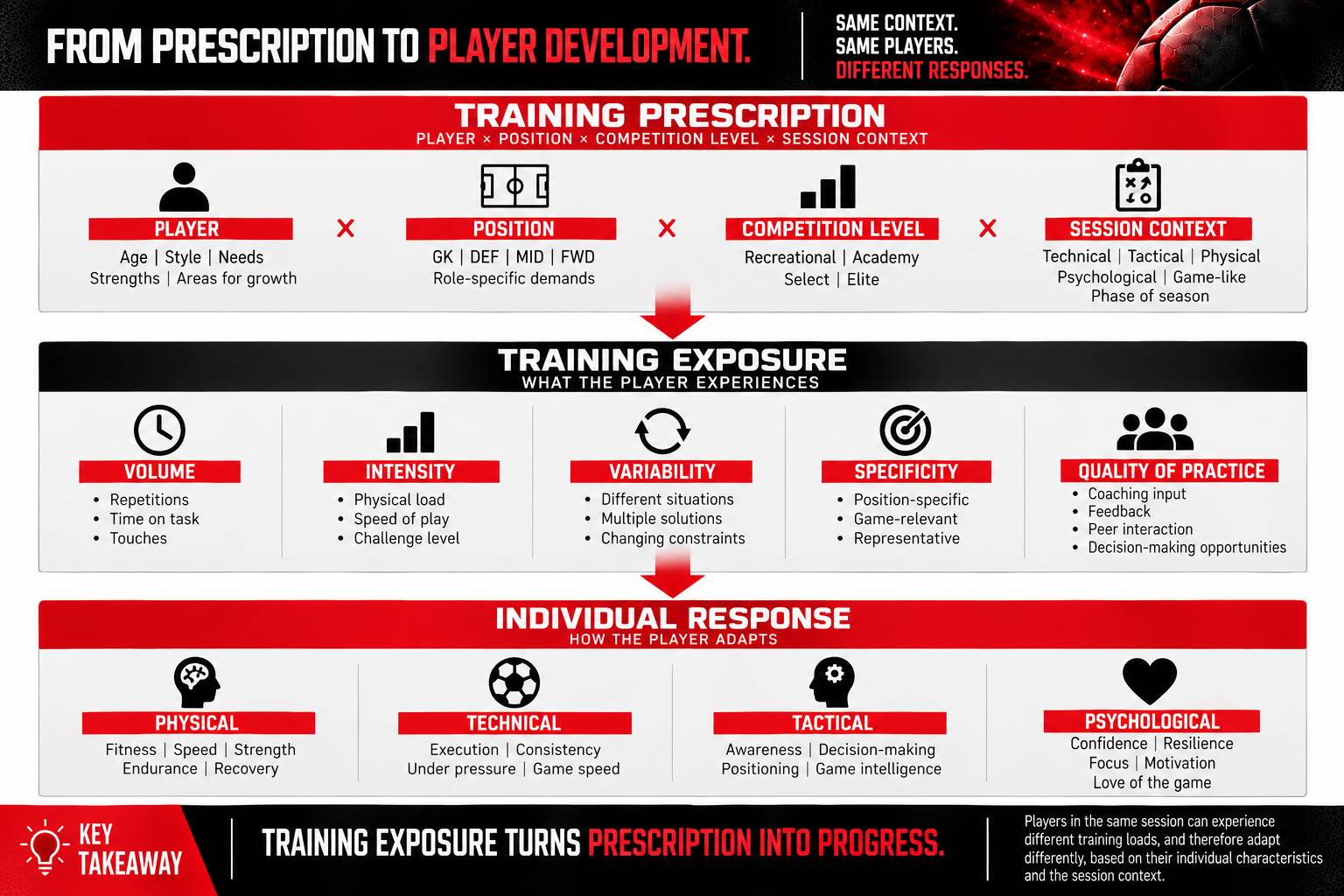
This framework extends beyond the variables directly tested in this analysis.
It should therefore be interpreted as an applied conceptual model informed by the findings, rather than as a statistical model tested in its entirety.
A coach can prescribe the session.
But the session occurs within the realities of the athlete and the training environment.
Tactical role is associated with different movement demands.
Training exposure can differ according to competition level.
The characteristics of an individual session change the demands that emerge.
And individual athletes can experience those demands differently.
The written training plan represents the prescription.
It should not automatically be treated as the player’s actual exposure or response.
What Does This Mean for Player Development?
Many soccer organizations use standardized curricula or common session structures across multiple teams.
There are good reasons for doing so.
A curriculum can establish common principles, improve organizational alignment, support coach education, and provide a coherent developmental framework.
The problem is therefore not standardization itself.
The problem occurs when:
Standardizing the training prescription is assumed to standardize the training response.
The external literature reinforces why that assumption deserves scrutiny.
Dellal et al. (2011) showed that standard of play was associated with different responses within similar soccer activities.
Mara et al. (2016) demonstrated that game format altered physical and physiological demands in elite women.
Lacome et al. (2018) demonstrated that a common small-sided-game format did not necessarily impose an equivalent stimulus across players.
The present findings add another layer by demonstrating that competition level, tactical position, and session context interacted within the training environment.
A common curriculum can therefore provide the framework while coaches remain responsive to the players experiencing it.
That may mean manipulating an activity differently for different groups.
It may mean recognizing positional differences in exposure.
It may mean providing supplementary physical work when appropriate.
Or it may mean modifying subsequent training or recovery according to what individual athletes actually experienced.
Monitoring What Training Actually Produces
This is where monitoring becomes valuable.
GPS, accelerometry, heart-rate monitoring, physical testing, and coaching observation should not replace coaching judgment.
Instead, they can help practitioners compare:
WHAT WAS INTENDED
with
WHAT ACTUALLY OCCURRED
The training plan alone cannot tell us whether every player received the intended exposure.
Rather than simply asking:
“Did we complete the session?”
the applied question becomes:
“What did the session actually produce for the players who completed it?”
That shift moves monitoring away from collecting data for its own sake and toward understanding the player-development environment.
Study Context and Interpretation
These findings should be interpreted within the context of the study.
The sample consisted of 47 female youth soccer players between 14 and 17 years of age, and the training responses reflect the specific players, activities, and sessions examined.
The findings should therefore not be interpreted as universal positional or competition-level benchmarks.
The observational comparisons also do not establish that competition level, tactical position, or session context independently caused the observed differences.
Instead, the findings demonstrate how training demands differed within the standardized soccer training environment examined in this research and highlight the importance of considering competition level, tactical position, and session context when interpreting player load.
This distinction is central to the applied interpretation of the study.
The objective is not to prescribe universal workload values for forwards, midfielders, or defenders.
It is to demonstrate why practitioners should be cautious about assuming that a common training prescription produces a common player exposure.
From Talent Identification to Player Development
This brings the present findings back to the larger progression of the STRIKES™ research series.
Relative age reminds us that developmental opportunity is not distributed evenly.
Biological maturation reminds us that the physical characteristics observed in youth players exist within a changing developmental process.
Talent identification and selection remind us that current performance should not automatically be treated as future potential.
The physical-performance findings demonstrated that Advanced players were not simply superior across every physical quality.
The present findings add another layer:
Players participating within the same overall training structure do not necessarily experience the same demands.
The broader women’s soccer literature supports the importance of context.
Mohr et al. (2008) demonstrated that performance level and tactical position were associated with differences in match activity. Gabbett and Mulvey (2008) showed that training games could reproduce important aspects of match play while not necessarily reproducing every high-intensity demand encountered during competition.
Together, these findings move the discussion away from viewing development as a simple process of identifying the best players and giving them the same “best” training program.
Development occurs through an evolving interaction between the athlete and the environment.
The role of an effective player-development system is therefore not simply to provide training.
It is to continually evaluate:
What is that training producing?
The STRIKES™ Research Insight
The most important conclusion from these data is not simply that different players accumulated different training loads.
It is more specific.
Training prescription and training exposure should not be treated as interchangeable.
Position was associated with different workload profiles.
Competition level added another layer of variation.
And when individual sessions were examined, those relationships could change again.
The significant Muscle Load interaction captures the central finding:
The difference between Advanced and Competitive players depended on both tactical position and session context.
If we look only at the session plan, we know what the coach intended to prescribe.
If we look only at the team average, we know something about what the group experienced overall.
But neither necessarily tells us what happened to an individual athlete.
For coaches, this does not mean abandoning team training or standardized curricula.
It means recognizing their limitations.
A common training structure can provide consistency without producing uniform exposure across players.
The challenge for applied sport science is therefore not simply to quantify what the team completed.
It is to understand what individual players experienced and whether those exposures support their development.
Practical Applications for Coaches
- Don’t assume the team average represents every player. Group-level data can conceal meaningful positional and session-specific responses.
- Interpret training load within positional context. Forwards, midfielders and defenders can experience different demands within the same overall training structure.
- Consider competition level without assuming a uniform effect. Advanced and Competitive players did not differ in the same way across every position or training-load variable.
- Examine individual sessions—not only pooled averages. The Muscle Load findings demonstrate that combining multiple sessions can conceal meaningful interactions.
- Interpret external and internal load together. Greater external workload does not automatically correspond with greater cardiovascular load.
- Use a curriculum as a framework, not a guarantee of equivalent exposure. Standardizing the session does not guarantee that every athlete experiences the same physical or physiological stimulus.
- Monitor what the training produces. Move beyond asking whether the session was completed and evaluating whether individual players received appropriate developmental exposures.
Conclusion
The same soccer training structure did not produce a uniform training experience across the players examined in this research.
Positional roles demonstrated different descriptive workload profiles.
Competition level added another layer of variation.
And when individual training sessions were examined, those relationships changed again.
Muscle Load provides perhaps the clearest example.
When averaged across all three sessions, there was no overall competition-level difference.
Yet a significant time × competition level × tactical position interaction revealed substantially different patterns underneath that average.
Advanced midfielders demonstrated greater Muscle Load across all three sessions.
Advanced defenders demonstrated greater Muscle Load during Sessions 1 and 3, but not Session 2.
And among forwards, the direction of the competition-level difference actually reversed during Session 2.
Other training-load measures reinforced the complexity.
Total Distance demonstrated its own position- and session-specific interaction.
High-Intensity Running differed according to competition level and session but did not demonstrate the same three-way positional interaction.
Cardio Load provided additional evidence that external work and internal physiological response should not be treated as interchangeable.
For coaches, this does not mean abandoning team training, shared methodologies, or standardized curricula.
It means recognizing what those systems can—and cannot—standardize.
A coach can standardize the training prescription.
The coach cannot assume that doing so standardizes the training exposure.
Player development therefore requires us to look beneath the session plan and, at times, beneath the team average.
The question is not simply:
“What training did we prescribe?”
It is:
“What did the player actually experience?”
The session is designed for the team. The stimulus is experienced by the player.
References
Dellal, A., Hill-Haas, S., Lago-Peñas, C., & Chamari, K. (2011). Small-sided games in soccer: Amateur vs. professional players’ physiological responses, physical, and technical activities. Journal of Strength and Conditioning Research, 25(9), 2371–2381. https://doi.org/10.1519/JSC.0b013e3181fb4296
Gabbett, T. J., & Mulvey, M. J. (2008). Time-motion analysis of small-sided training games and competition in elite women soccer players. Journal of Strength and Conditioning Research, 22(2), 543–552. https://doi.org/10.1519/JSC.0b013e3181635597
Hill-Haas, S. V., Dawson, B., Impellizzeri, F. M., & Coutts, A. J. (2011). Physiology of small-sided games training in football: A systematic review. Sports Medicine, 41(3), 199–220. https://doi.org/10.2165/11539740-000000000-00000
Lacome, M., Simpson, B. M., Cholley, Y., Lambert, P., & Buchheit, M. (2018). Small-sided games in elite soccer: Does one size fit all? International Journal of Sports Physiology and Performance, 13(5), 568–576. https://doi.org/10.1123/ijspp.2017-0214
Mara, J. K., Thompson, K. G., & Pumpa, K. L. (2016). Physical and physiological characteristics of various-sided games in elite women’s soccer. International Journal of Sports Physiology and Performance, 11(7), 953–958. https://doi.org/10.1123/ijspp.2015-0087
Mohr, M., Krustrup, P., Andersson, H., Kirkendal, D., & Bangsbo, J. (2008). Match activities of elite women soccer players at different performance levels. Journal of Strength and Conditioning Research, 22(2), 341–349. https://doi.org/10.1519/JSC.0b013e318165fef6
Rampinini, E., Impellizzeri, F. M., Castagna, C., Abt, G., Chamari, K., Sassi, A., & Marcora, S. M. (2007). Factors influencing physiological responses to small-sided soccer games. Journal of Sports Sciences, 25(6), 659–666. https://doi.org/10.1080/02640410600811858
Explore More STRIKES™ Applied Sport Science
Synergy Athletic Solutions Applied Sport Science in Soccer — YouTube
© 2026 Synergy Athletic Solutions — STRIKES™ Applied Sport Science