
Teaching the Turn Is not the Goal: From Technique to Problem Solving in U8 Soccer
Joshua Villalobos, PhD
Founder, Synergy Athletic Solutions
STRIKES™ Applied Coaching #001
Session: U8 Girls Recreational Soccer
Observed Training Duration: 61:27
Applied question: Can a progressively designed training environment provide young players with movement, technical, perceptual, and decision-making opportunities to explore change of direction as a solution to game problems?
Four findings:
- Training progressed from prescribed technique toward opposed and representative soccer problems.
- As coaching prescription decreased, perceptual and decision-making demands increased.
- Targeted behaviors emerged during the game alongside movement, technical and decision-making constraints.
- The representative game revealed a training-design constraint that can now be manipulated and reassessed.
Introduction
When we teach a young soccer player how to turn, what are we actually trying to develop?
It is easy to evaluate success by watching whether the player can correctly perform an inside-foot turn, outside-foot turn, pullback, or another change-of-direction technique.
But soccer presents a more complicated problem.
Players must not only possess the technical ability to change direction. They must recognize when changing direction may be useful, why it may solve the immediate problem, and how to execute the action while responding to defenders, space, teammates, and the ball.
This distinction was the starting point for the first STRIKES™ Applied Coaching analysis.
Rather than examining a selected drill or highlighting only successful moments, I retrospectively analyzed an entire 61-minute, 27-second U8 girls recreational training session.
The objective was not to determine whether the practice was “good” or “bad.”
Instead, I wanted to ask a more useful coaching question:
Did the training environment progressively provide players with opportunities to develop change of direction from a prescribed technique into a potential solution to problems encountered in the game?
Four findings emerged from the session.
Finding 1: The Session Progressed From Technique Toward the Game
The session was intentionally designed as a progression.
Players initially encountered movement and deception activities before progressing into more deliberate technical change-of-direction work. Opposition was then introduced through 1v1 activities before the session concluded with a representative 4v4 + goalkeeper game.
Analysis of the complete session showed approximately:
| Training component | Duration | Session allocation |
| Movement/deception | ~6:15 | 10.2% |
| Technical/COD development | ~23:15 | 37.8% |
| Opposed 1v1 | ~11:20 | 18.4% |
| Representative game | ~16:00 | 26.0% |
| Major instruction/transitions/closing | ~4:37 | 7.5% |
| Total | 61:27 | 100% |
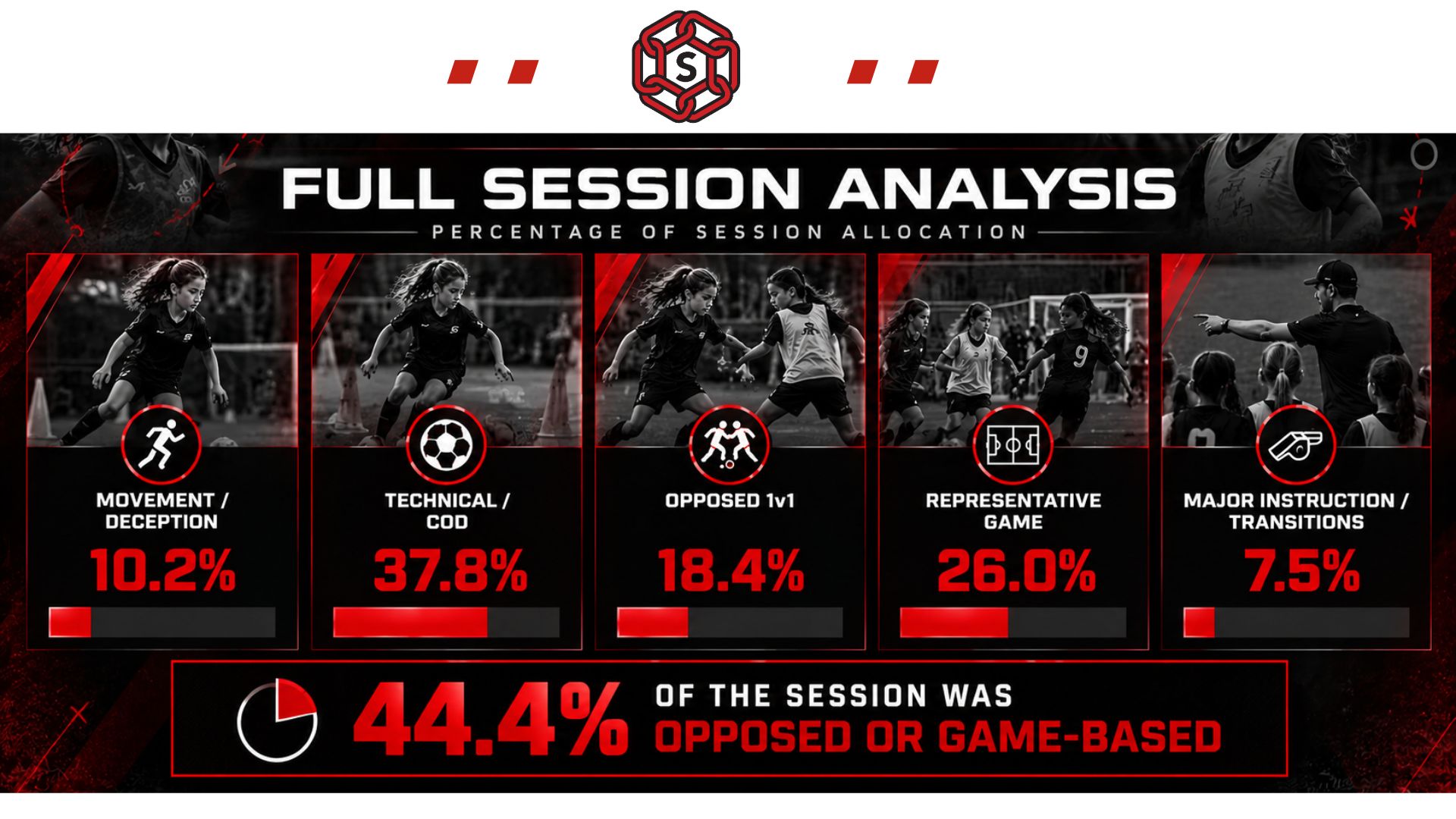
Approximately 82% of the session was organized around developmental activities, with major instruction, transitions, and closing periods accounting for the remainder.
More importantly, approximately 44.4% of the entire session occurred in opposed or representative environments.
This matters because the developmental objective was not simply to accumulate repetitions of a turn.
The objective was to progressively change the problem presented to the player.
During technical practice, the primary question was:
How do I change direction?
During 1v1:
Can I change direction against an opponent?
And during the game:
When and why should I change direction?
This created a progression from:
HOW?
↓
HOW + AGAINST WHOM?
↓
WHEN + WHY + HOW?
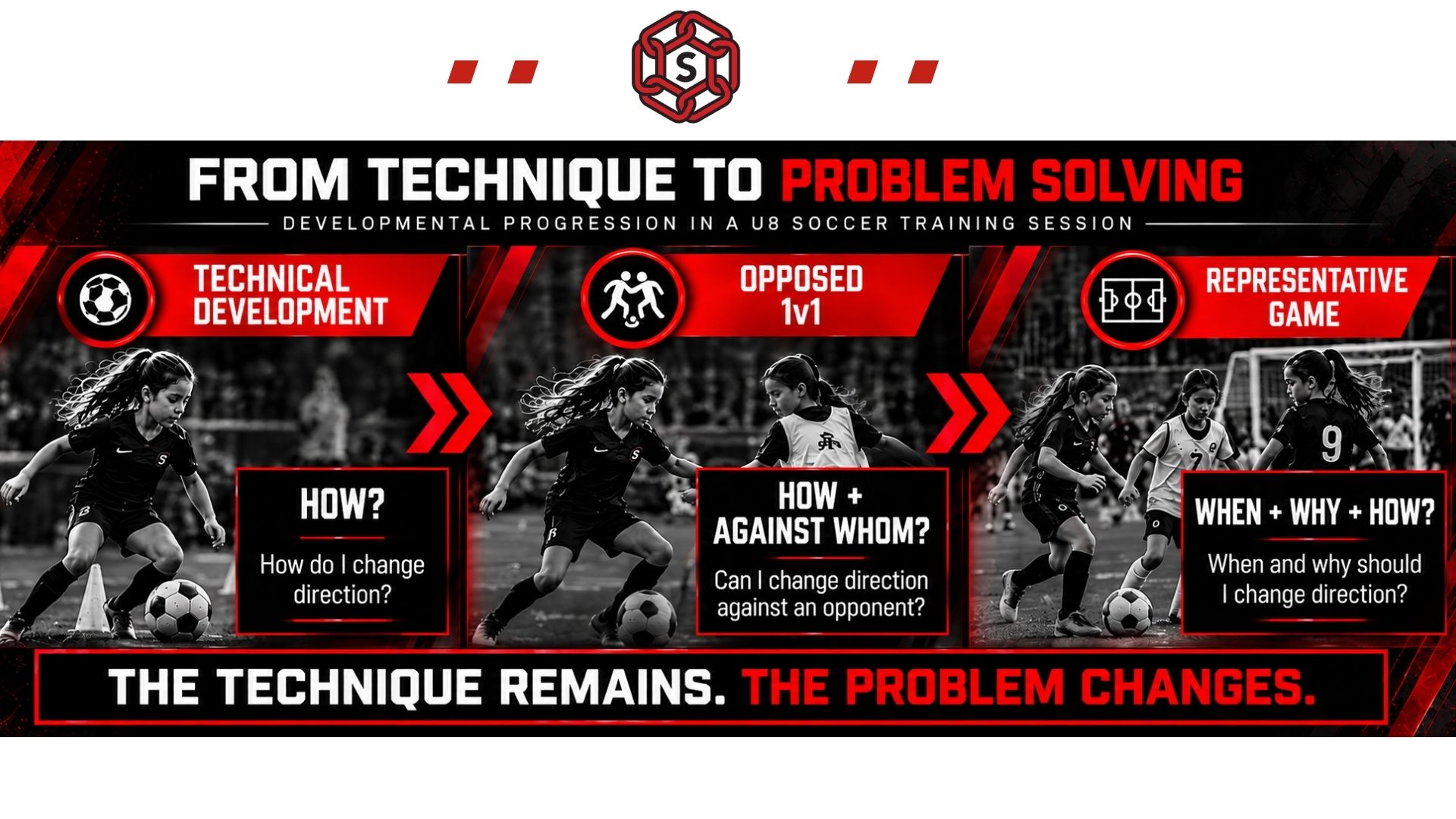
The technique remained relevant throughout the session.
What changed was the context in which the technique had to be used.
Finding 2: As Prescription Decreased, Perception and Decision-Making Increased
One of the clearest observations from the session was that the coach increasingly surrendered control of the solution.
During the more controlled technical activities, much of the answer was provided to the player.
The activity established the movement.
The activity established the direction.
And, frequently, the activity established when the change of direction should occur.
That environment can provide valuable opportunities to develop ball manipulation, foot placement, balance, deceleration, reorientation, and reacceleration.
But the informational problem changes when a defender is introduced.
In the 1v1 environment, the defender becomes a source of information.
The player must begin perceiving:
- Where is the defender?
- Where is the available space?
- Which goal or direction is available?
- Can I continue forward?
- Do I need to change direction?
By the time players enter the 4v4 game, the coach no longer determines when a turn should occur.
The game does.
The relationship therefore became:
COACH PRESCRIPTION ↓
while
OPPONENT INFORMATION ↑
PERCEPTUAL UNCERTAINTY ↑
AVAILABLE SOLUTIONS ↑
DECISION-MAKING DEMAND ↑
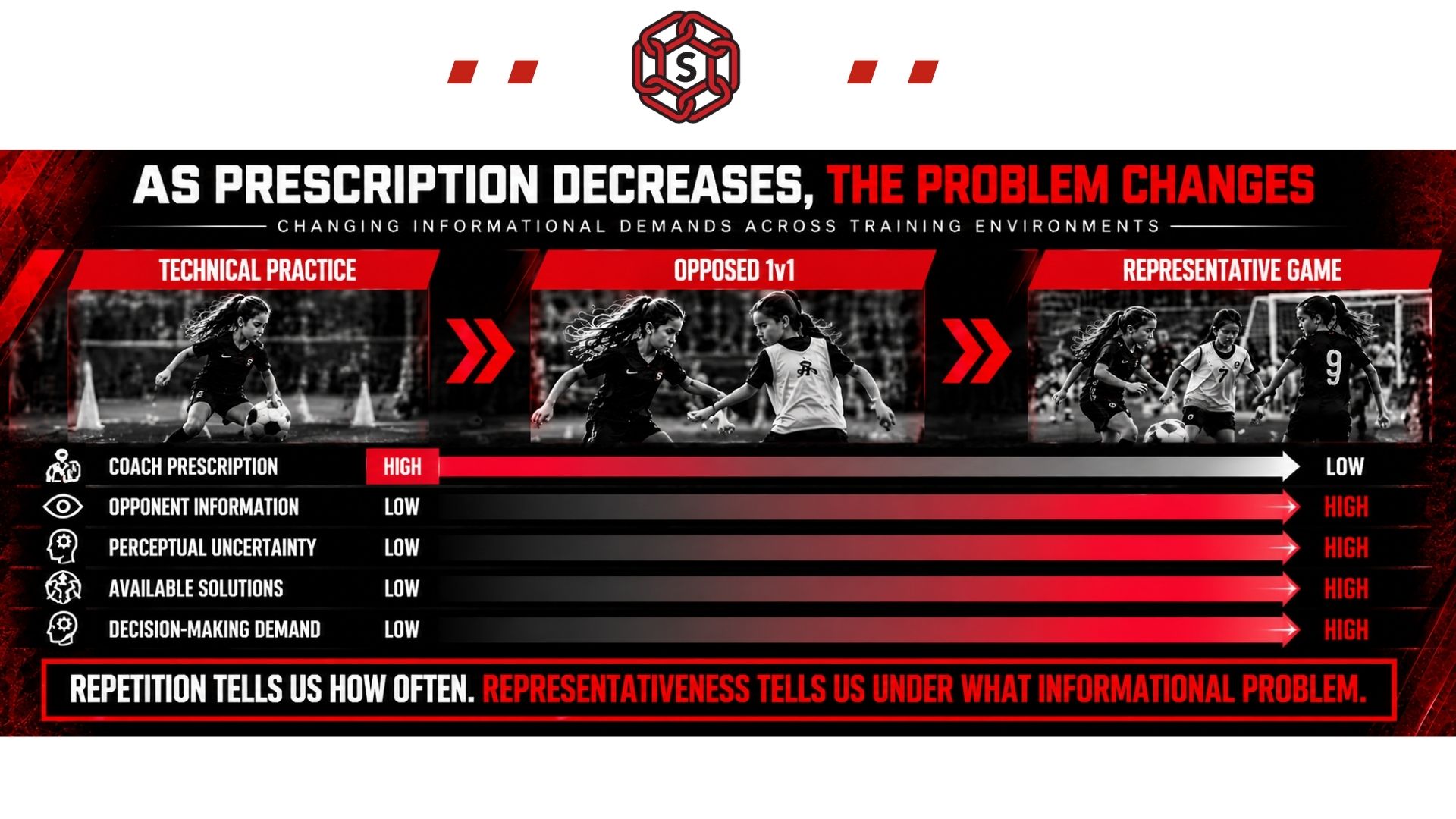
This distinction has important implications for how we think about repetition in player development.
A prescribed turn and a self-selected change of direction during a game may look mechanically similar.
Developmentally, however, they are not necessarily the same experience.
The first may primarily require execution.
The second may require perception, decision-making and execution.
Repetition volume tells us how often an action occurred.
Representativeness tells us something about the informational problem under which it occurred.
Both matter.
Finding 3: The Desired Behavior Emerged in the Game but So Did the Constraints
One sequence from the 4v4 game was particularly interesting.
A player received or controlled the ball while encountering defensive pressure.
Rather than simply continuing into the defender, she altered her direction and orientation, moved away from pressure, identified available space, maintained the attack, and ultimately generated a shot.
The sequence can be represented as:
PRESSURE
↓
PERCEPTION OF SPACE
↓
CHANGE OF DIRECTION
↓
SEPARATION / NEW SPACE
↓
CONTINUED ATTACK
Video 1. Emergence of change-of-direction behavior during the representative 4v4 game. The player responds to defensive pressure, changes direction, creates separation, and continues the attack. The sequence demonstrates the targeted behavior emerging in representative play; it does not establish that the earlier training activities caused the behavior.
This is exactly the type of behavior the earlier activities were intended to support.
But an important distinction is necessary.
The sequence does not prove that the earlier turning activities caused the later action.
A single training session cannot establish that causal relationship.
What we can say is more precise and arguably more useful:
A behavior targeted earlier in the session subsequently emerged within the representative game environment without the coach prescribing the solution.
That is something worth observing.
Just as importantly, the successful sequence was not representative of every attempt.
Players also lost control of the ball.
Some directional changes lacked sufficient deceleration.
Some players struggled to reposition their bodies before accelerating again.
At times the ball became separated from the player during the movement.
And in other situations, a potential directional solution appeared available but was not selected.
Those moments shouldn’t be removed from the analysis.
They may be where some of the most useful coaching information exists.
The session suggested that change of direction in soccer cannot be reduced to knowing a particular turn.
Instead, successful application involves interacting capacities:
MOVEMENT CAPACITY
Can the player physically redirect her body?
↓
TECHNICAL CAPACITY
Can she manipulate the ball while changing direction?
↓
PERCEPTION
Can she recognize pressure and available space?
↓
DECISION
Can she determine whether changing direction is an appropriate solution?
↓
ACTION
Can she execute the solution and continue playing?
These shouldn’t be interpreted as rigid sequential stages.
Movement, technique, perception, and decision-making continually interact during play.
For a developing U8 player, knowing how to perform a turn and recognizing when that turn might solve a soccer problem are related but different developmental challenges.
Finding 4: The Game Revealed a Problem With the Training Environment
The representative game also exposed something I would change.
The ball left the playing area frequently enough that continuity became an identifiable constraint within the training environment.
At first glance, this could simply be interpreted as a player problem.
Young players need better ball control.
Passes travel out of bounds.
Dribbles escape the playing area.
Shots miss their intended target.
But Applied Coaching requires examining the environment as well as the player.
Every extended restart reduces the amount of time players spend perceiving, deciding, moving, defending, attacking, and interacting with the ball.
The coaching question therefore becomes:
How can I preserve the problem presented by the game while increasing the players’ exposure to it?
The answer is not necessarily to remove the 4v4 game.
Doing so might increase technical repetition while simultaneously removing some of the very information I want players to learn to use.
Instead, the next adaptation should preserve the representative environment while improving its continuity.
For example:
More immediately available balls
↓
Faster restarts
↓
Less time retrieving balls
↓
More representative playing exposure
This creates a measurable question for a subsequent session:
Can the restart process be modified to increase game exposure while preserving the same developmental problem?
And that question illustrates an important distinction within STRIKES™ Applied Coaching.
The purpose of analysis isn’t simply to evaluate the session that already happened.
The purpose is to inform the session that happens next.
From Teaching a Technique to Developing a Player
The full-session analysis changed how I interpret this practice.
If I evaluated only the technical portion, I might ask:
Did the players perform the turns correctly?
If I evaluated only the successful game sequence, I might conclude:
The practice worked.
Neither interpretation is sufficient.
The complete session revealed something more nuanced.
Players were provided opportunities to develop the physical and technical foundations of changing direction.
Opposition then introduced uncertainty.
The representative game required players to select solutions independently.
Some desired behaviors emerged.
Other attempts revealed technical, movement, perceptual, and decision-making constraints.
And the game itself revealed a constraint within my training design.
That is considerably more useful than labeling the session successful or unsuccessful.
The STRIKES™ Applied Coaching Process
This first analysis helped clarify the framework I want STRIKES™ Applied Coaching to follow.

DESIGN
What am I trying to develop, and what environment have I created?
↓
MEASURE
What actually occurred within that environment?
↓
OBSERVE
What behaviors, successes, struggles, and constraints emerged?
↓
INTERPRET
What might those observations tell me about the players and the training environment?
↓
ADAPT
What should I manipulate in the next exposure?
↓
REASSESS
Did that change produce the response I intended?
And then the process begins again.
DESIGN → MEASURE → OBSERVE → INTERPRET → ADAPT → REASSESS
The goal is not to turn every practice into a research experiment.
It is to become more systematic about connecting coaching intention, training design, player behavior, and subsequent coaching decisions.
Applied Coaching Insight
Perhaps the most important lesson from this first analysis is simple:
Teaching the turn is not the goal.
The turn is one potential solution.
The developmental objective is creating players who increasingly possess the movement and technical capacities to execute different solutions, the perceptual and decision-making abilities to recognize when those solutions may help them solve the problems soccer presents.
For this U8 group, that process is understandably still developing.
The session contained successful actions.
It contained unsuccessful actions.
It contained moments where players recognized the problem but struggled to execute the solution.
And it contained moments where the training environment itself could have been better.
All of those observations have value.
Because player development isn’t simply about designing the next drill.
It’s about creating a developmental environment, observing how players interact with it, and allowing what happens to inform what comes next.
Create the problem.
Allow exploration.
Observe the solutions.
Identify the constraints.
Adapt the environment.
Reassess.
That is where training begins to become a developmental process.
Explore More STRIKES™ Applied Sport Science
Synergy Athletic Solutions Applied Sport Science in Soccer — YouTube
© 2026 Synergy Athletic Solutions — STRIKES™ Applied Coaching