
What Physically Separates Advanced Soccer Players?
Physical Characteristics of Advanced vs. Competitive Female Soccer Players | STRIKES™ Applied Sport Science
By Dr. Joshua Villalobos, PhD
Founder, Synergy Athletic Solutions
STRIKES™ Applied Sport Science
When we talk about advanced soccer players, it is tempting to assume that they are simply faster, fitter, stronger, and more powerful across the board.
But player development is rarely that simple.
In my research examining youth female soccer players competing at different levels, Advanced and Competitive players were assessed across several physical-performance characteristics before completing the training component of the study.
The results revealed an important distinction:
Advanced players were not superior in every physical test.
Instead, differences emerged in specific physical qualities and some of those differences were considerably stronger than others.
The Advanced players demonstrated significantly better performance in 30-meter sprinting, change-of-direction ability, countermovement jump height, relative VO₂max, and velocity at VO₂max.
At the same time, the groups were remarkably similar in 10-meter sprint performance. Differences at 20 meters did not reach statistical significance, while absolute VO₂max was higher among Advanced players but fell just short of the conventional threshold for statistical significance.
Taken together, these findings suggest that competition level may be associated with a multidimensional physical-performance profile rather than superiority in one isolated athletic quality.
That distinction has important implications for how we identify and more importantly, develop soccer players.
Advanced Players Were Not Better at Everything
Before examining individual physical qualities, it is useful to look at the overall pattern.
The Advanced group demonstrated statistically significant advantages in:
- 30-meter sprint performance
- Illinois Agility Test performance
- countermovement jump height
- relative VO₂max
- velocity at VO₂max
However, significant differences were not observed for 10-meter sprint performance, 20-meter sprint performance, or absolute VO₂max.
That matters.
If competition level were simply a reflection of general athletic superiority, we might expect Advanced players to outperform Competitive players across virtually every test.
That did not happen.
Instead, the results suggest a more nuanced physical profile.
Figure 1. What Physical Qualities Separate Advanced Soccer Players?
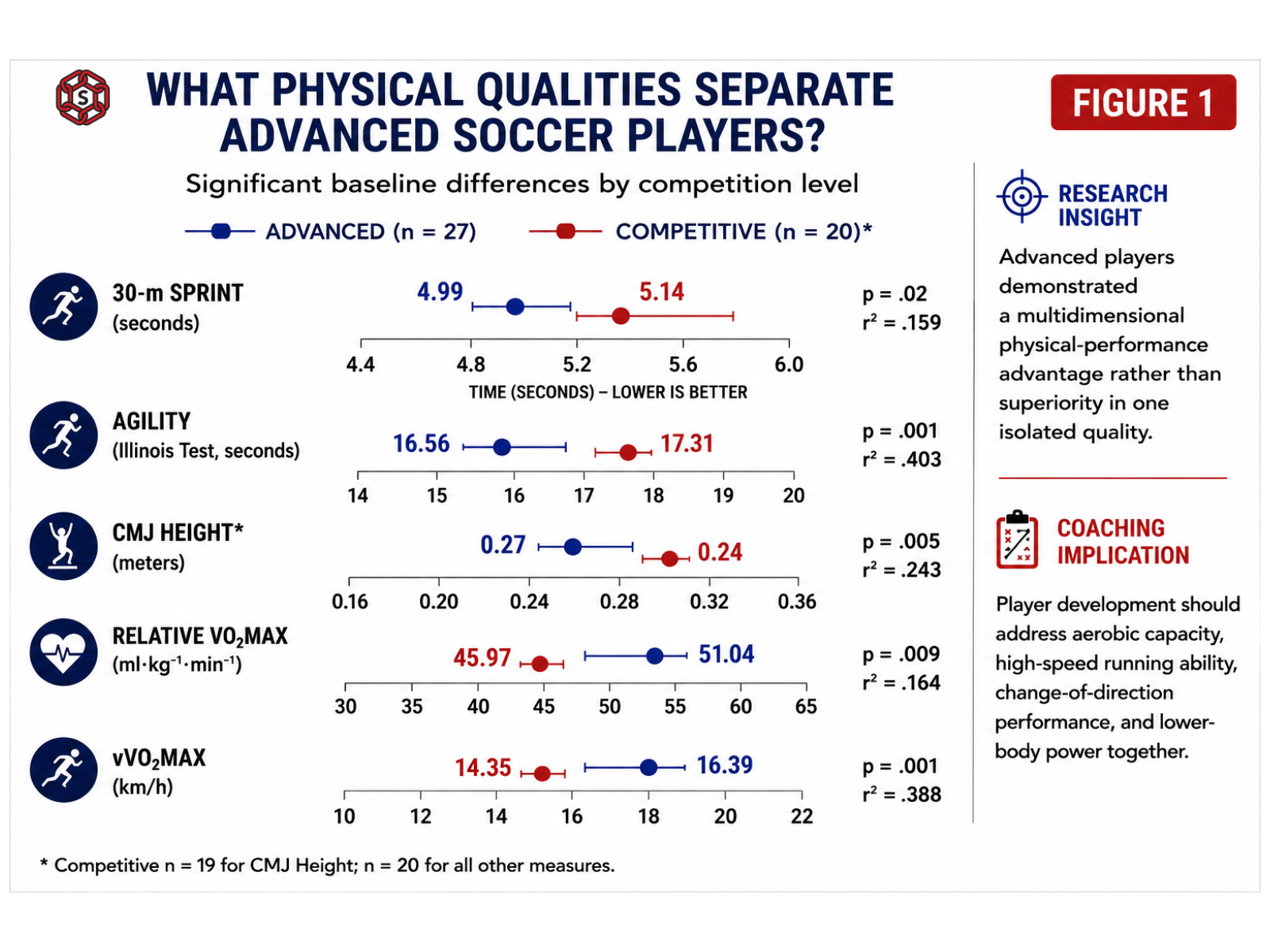
The pattern shown in Figure 1 is perhaps more important than any single result.
The Advanced players demonstrated advantages across aerobic capacity, longer-distance sprint performance, change-of-direction performance, and lower-body explosive power.
This supports the idea that progression toward higher levels of soccer may involve the interaction of multiple physical qualities rather than the development of one dominant characteristic.
Recent evidence across women’s soccer provides important context. Compton et al. (2026) conducted a systematic review and meta-analysis examining physical performance qualities across the women’s football performance scale. The analysis included 18,722 athletes and investigated cardiorespiratory fitness, sprinting, acceleration, change of direction, lower-limb power, lower-limb strength, and maximal velocity. Their findings indicated that intermittent aerobic capacity, sprint performance, and lower-limb power were generally greater at higher performance tiers (Compton et al., 2026).
Earlier research also demonstrated that the physical demands of women’s soccer vary according to standard of competition. Datson et al. (2014), for example, reported that elite female players completed approximately 28% more high-speed running and 24% more sprinting than moderate-level players.
Collectively, these findings reinforce an important player-development concept: as the competitive environment changes, the physical capacities associated with successful participation may also change.
But which physical qualities showed the largest differences in my research?
That provides another layer to the analysis.
Which Physical Qualities Showed the Strongest Effects?
Statistical significance tells us whether there is evidence of a difference between groups.
It does not necessarily tell us how substantial that difference may be.
Examining the reported competition-level effect sizes provides additional perspective.
Figure 2. Which Physical Qualities Showed the Strongest Competition-Level Effects?
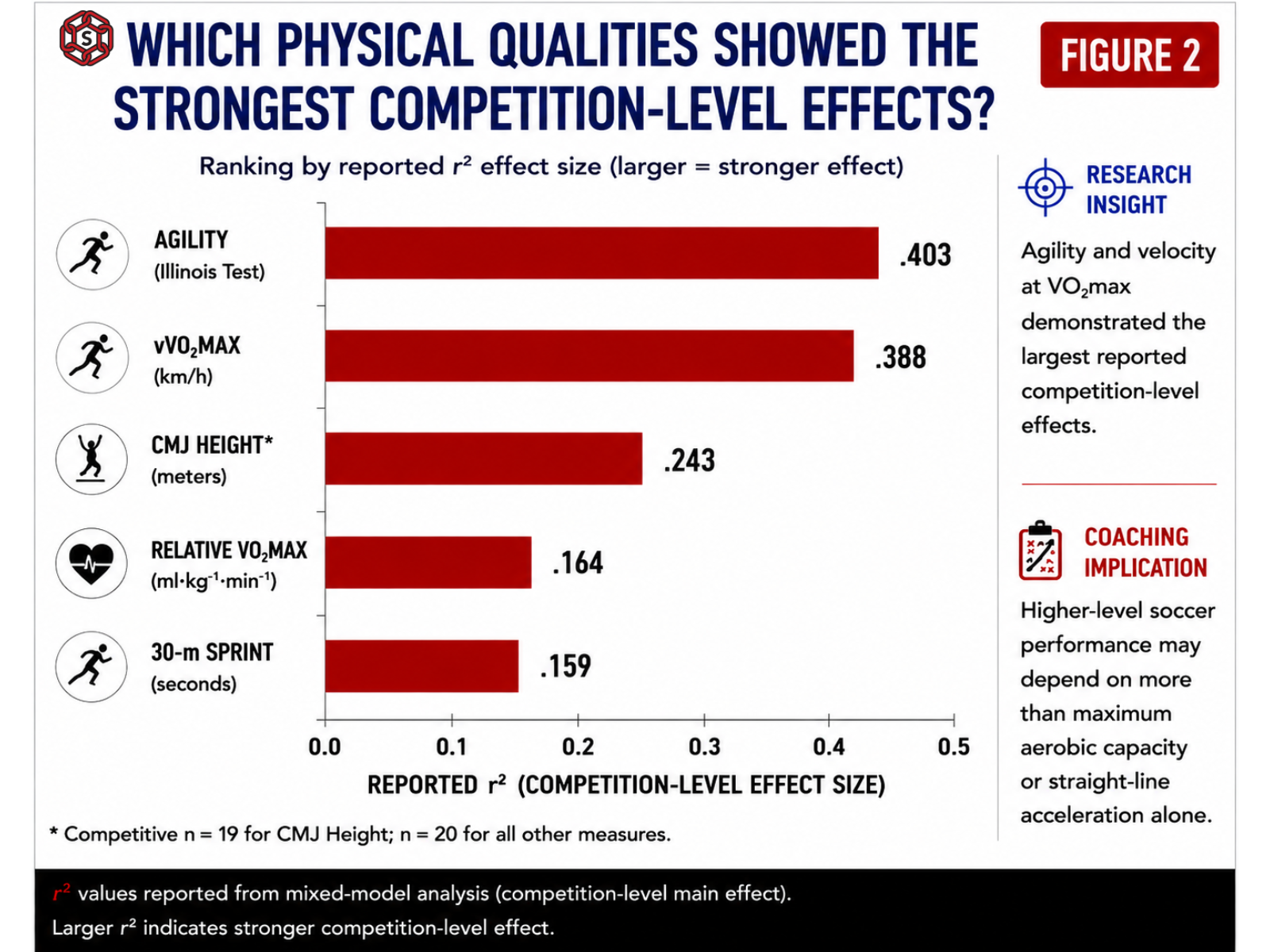
The largest reported competition-level effects were:
Illinois Agility Test: r² = .403
vVO₂max: r² = .388
CMJ Height: r² = .243
Relative VO₂max: r² = .164
30-m Sprint: r² = .159
Two qualities stand out.
Change-of-direction performance and velocity at VO₂max demonstrated the largest reported competition-level effects.
That is particularly interesting from an applied soccer perspective.
Soccer is not simply an endurance sport.
It is not simply a sprinting sport.
And it is certainly not a sport performed exclusively in straight lines.
Players must repeatedly accelerate, decelerate, change direction, reposition, recover, and perform technical actions while responding to constantly changing information.
The physical qualities that distinguished the groups therefore appear consistent with the multidimensional nature of the sport.
This does not mean agility or vVO₂max independently caused players to reach the Advanced level.
The comparisons are cross-sectional.
Instead, these characteristics describe physical differences that existed between the groups when they were assessed.
Those differences could reflect many interacting factors, including previous training, biological development, accumulated playing experience, selection processes, competition environment, and underlying individual characteristics.
That distinction is essential when interpreting physical testing within player development.
Sprint Performance: The Difference Emerged at 30 Meters
The sprint results provide one of the clearest examples of why physical performance should not be reduced to a statement such as:
“Advanced players are faster.”
The reality was more interesting.
Figure 3. Sprint Performance: The Difference Emerged at 30 Meters
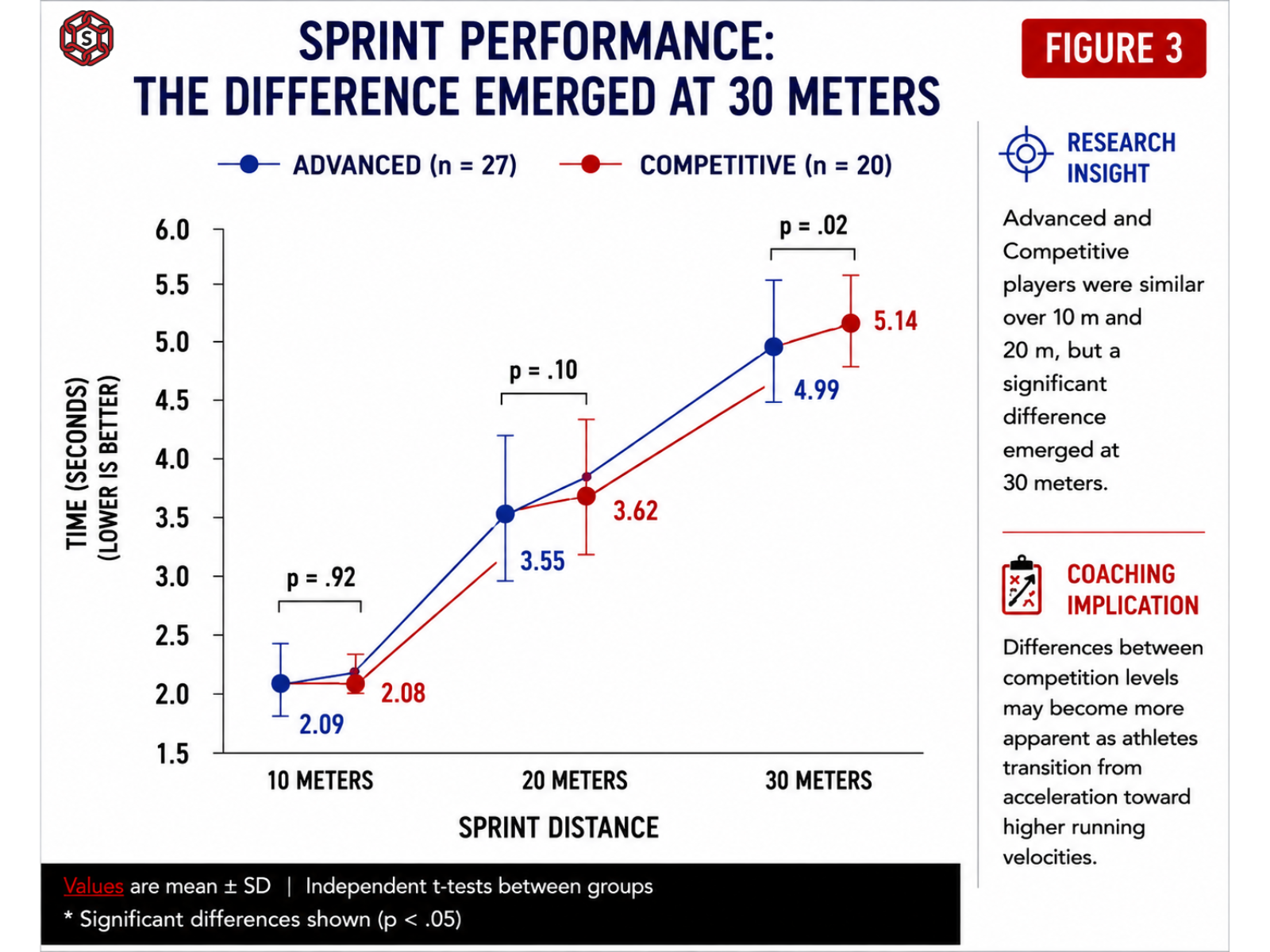
Over 10 meters:
Advanced: 2.09 ± 0.10 seconds
Competitive: 2.08 ± 0.10 seconds
p = .92
The groups were essentially identical.
At 20 meters:
Advanced: 3.55 ± 0.16 seconds
Competitive: 3.62 ± 0.18 seconds
p = .10
A numerical difference had begun to appear, but it was not statistically significant.
At 30 meters:
Advanced: 4.99 ± 0.24 seconds
Competitive: 5.14 ± 0.29 seconds
p = .02, r² = .159
Now the difference was statistically significant.
The question isn’t simply whether a player is fast. It is where the difference begins to appear.
The Advanced players did not demonstrate an advantage during the earliest portion of acceleration.
Instead, separation became apparent over the longer sprint distance.
We should be cautious about interpreting a 30-meter sprint as a pure measure of maximal velocity. It is not.
However, these results suggest that competition-level differences became more apparent as sprint distance and consequently running velocity increased.
Research examining the development of high-level female players provides an interesting parallel.
Vescovi et al. (2011) evaluated 414 high-level female soccer players between 12 and 21 years of age. Sprint speed during the initial 9.1 meters was similar across chronological ages, whereas speed during the final 9.1-meter section, countermovement jump height, and agility performance improved until approximately 15–16 years of age.
The study also found additional differences in several sprint segments and Illinois agility performance between the 18–21-year-old and 14–17-year-old groups (Vescovi et al., 2011).
Although that study examined age-related development rather than the competition-level groups examined in my research, the findings provide useful context.
Short acceleration may not tell the complete story of an athlete’s sprint profile.
From a player-development perspective, coaches should therefore consider both acceleration ability and the athlete’s capacity to reach and express higher running velocities.
Aerobic Fitness: Absolute Capacity Tells Only Part of the Story
Aerobic fitness produced another important distinction.
There are multiple ways to express VO₂max.
Absolute VO₂max represents the total volume of oxygen consumed per minute.
Relative VO₂max expresses that capacity relative to body mass.
Both provide useful information, but they answer somewhat different questions.
Absolute VO₂max
Figure 4A. Absolute VO₂max: A Stronger Aerobic Capacity That Approached Significance
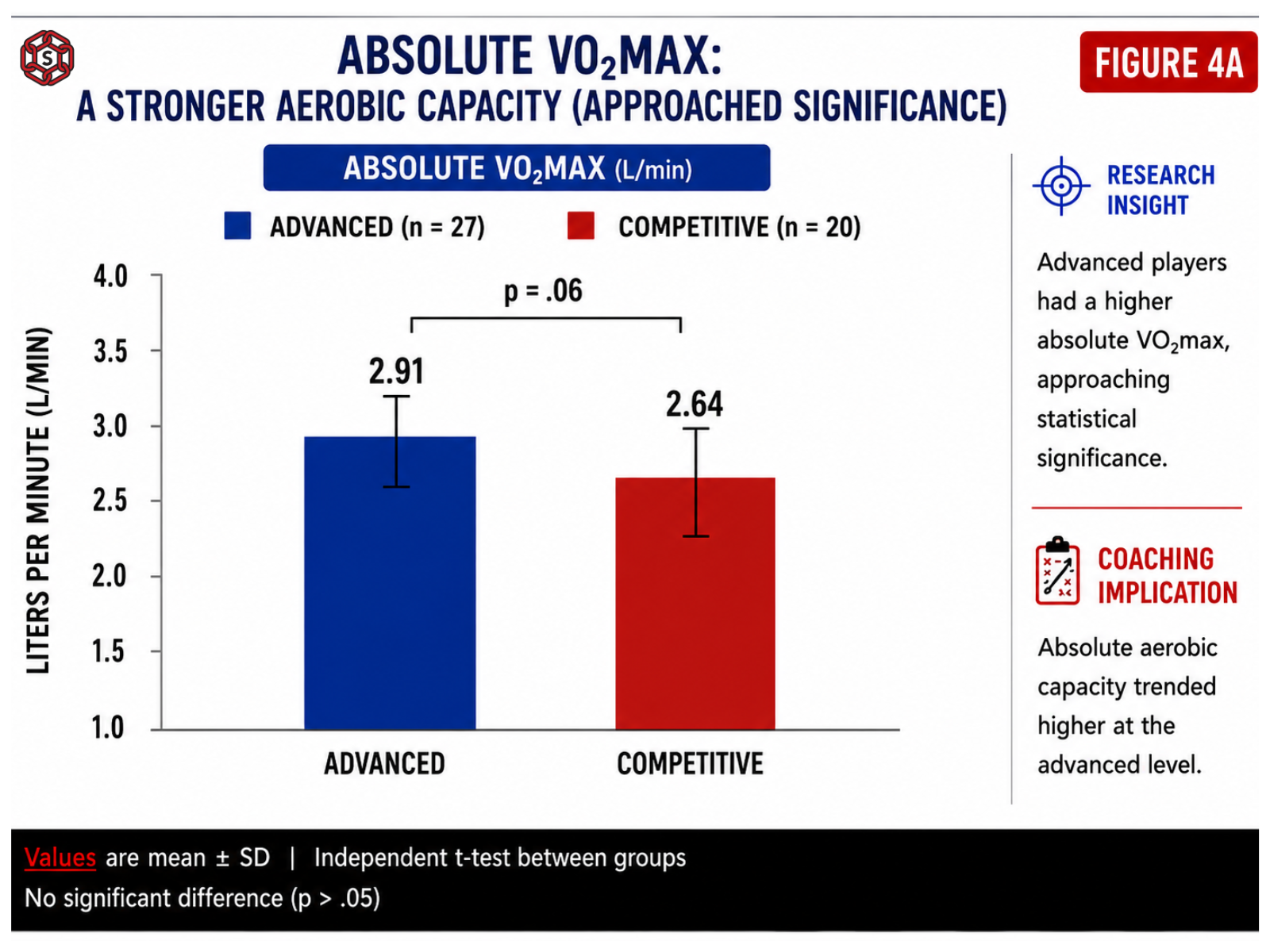
Advanced players:
2.91 ± 0.42 L/min
Competitive players:
2.64 ± 0.38 L/min
p = .06
The Advanced players demonstrated a higher average absolute VO₂max.
However, the difference did not reach the conventional p < .05 threshold for statistical significance.
Therefore, this result should not be described as a statistically significant difference.
At the same time, the numerical difference and p = .06 result are worth reporting rather than simply treating the groups as unquestionably identical.
The data indicate that absolute aerobic capacity trended higher in the Advanced group, but the evidence from this sample was insufficient to conclude that a statistically significant competition-level difference existed.
This is precisely why research interpretation should extend beyond simply labeling findings “significant” or “not significant.”
Relative VO₂max Clearly Separated the Groups
The picture changed when aerobic capacity was expressed relative to body mass.
Figure 4B. Relative VO₂max: A Significant Aerobic Capacity Advantage
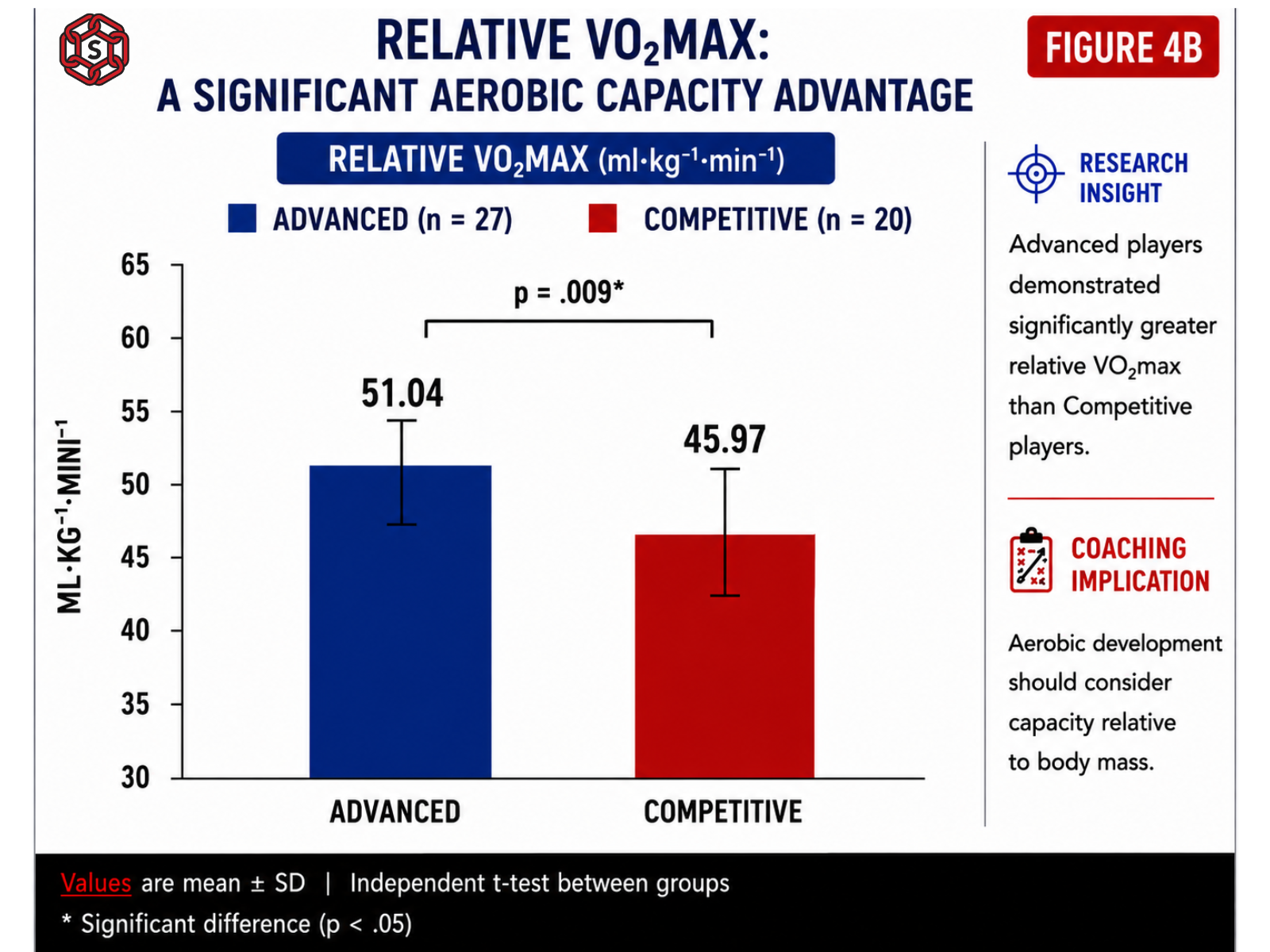
Advanced players:
51.04 ± 7.11 mL·kg⁻¹·min⁻¹
Competitive players:
45.97 ± 5.01 mL·kg⁻¹·min⁻¹
p = .009, r² = .164
Unlike absolute VO₂max, relative VO₂max significantly differentiated the two competition levels.
That distinction has practical relevance.
Soccer players repeatedly have to move their own body mass around the field.
Acceleration, deceleration, repositioning, pressing, recovery running, transitions, and repeated high-intensity actions all require the athlete to transport their body mass.
Expressing aerobic capacity relative to body mass therefore provides another perspective on the player’s capacity to support locomotor work.
The Advanced group’s mean relative VO₂max of approximately 51 mL·kg⁻¹·min⁻¹ also falls within values historically reported for elite female soccer players.
In their review of the applied physiology of female soccer, Datson et al. (2014) reported VO₂max values of approximately 49.4–57.6 mL·kg⁻¹·min⁻¹ among elite female players.
This does not mean that achieving a particular VO₂max determines whether an athlete becomes an Advanced player.
Instead, the comparison provides useful physiological context for the aerobic capacity observed in this group.
vVO₂max May Tell Us Something Even More Interesting
One of the strongest findings in the entire physical-performance analysis was velocity at VO₂max, or vVO₂max.
Advanced players:
16.39 ± 1.36 km/h
Competitive players:
14.35 ± 1.30 km/h
p = .001, r² = .388
The effect associated with competition level was substantial relative to the other physical characteristics examined.
This deserves particular attention.
VO₂max tells us something about the athlete’s aerobic capacity.
vVO₂max provides information about the running velocity associated with reaching VO₂max.
In practical terms, the Advanced group reached VO₂max at a higher running velocity.
Notice what happens when the aerobic findings are considered together:
Absolute VO₂max: higher in Advanced players but not statistically significant.
Relative VO₂max: significantly higher in Advanced players.
vVO₂max: significantly higher and one of the largest reported competition-level effects.
That progression provides a much more informative picture than simply saying:
“Advanced players had better endurance.”
The characteristics separating the groups appear to involve not only aerobic capacity but also the athlete’s ability to express that capacity while running.
Change-of-Direction Performance Produced the Largest Effect
The Illinois Agility Test produced the largest reported competition-level effect among the physical tests.
Advanced:
16.56 ± 0.52 seconds
Competitive:
17.31 ± 0.64 seconds
p = .001, r² = .403
That is an important finding because soccer performance occurs in an environment characterized by frequent changes in movement direction.
Players rarely accelerate in a straight line and simply continue running.
They brake.
Reaccelerate.
Turn.
Recover.
Close space.
Create separation.
Respond to opponents.
And perform these movements while simultaneously perceiving and processing information.
There is an important distinction here.
The Illinois Agility Test uses a predetermined movement path. Therefore, it does not reproduce the perceptual and decision-making demands associated with true reactive agility in soccer.
It is more appropriately interpreted here as a measure of pre-planned change-of-direction performance.
Nevertheless, the result indicates that the Advanced players performed substantially better when the physical task required repeated directional changes rather than simple straight-line acceleration.
From a development perspective, this suggests that coaches should not think about speed exclusively through linear sprinting.
Players need the physical capacity to produce, absorb, redirect, and reproduce force in multiple directions.
Lower-Body Explosive Power Also Differentiated Competition Level
Countermovement jump height provided another significant difference.
Advanced players:
0.27 ± 0.04 m
n = 27
Competitive players:
0.24 ± 0.04 m
n = 19
p = .005, r² = .243
The Competitive group contained one fewer valid CMJ observation than the other physical tests, which is why the sample size for this comparison was 19 rather than 20.
The Advanced group demonstrated greater lower-body explosive performance.
Again, this should not be interpreted as evidence that jumping ability alone determines soccer performance.
However, lower-body power contributes to many explosive actions that occur throughout soccer.
The broader women’s soccer literature supports the relevance of this quality. The systematic review and meta-analysis by Compton et al. (2026) identified lower-limb power as one of the physical qualities that tended to be greater at higher performance tiers.
The CMJ result therefore contributes another component to the multidimensional physical profile observed among the Advanced players.
A Physical Profile, Not a Single Magic Number
When all of the findings are viewed together, the central message becomes clearer.
The Advanced players were not distinguished by one extraordinary physical characteristic.
They demonstrated a profile.
They were faster over 30 meters.
They demonstrated better pre-planned change-of-direction performance.
They demonstrated greater countermovement jump height.
They possessed greater relative aerobic capacity.
And they reached VO₂max at a higher running velocity.
At the same time, they were not significantly different in 10-meter sprint performance, 20-meter sprint performance, or absolute VO₂max.
This is an important distinction for coaches and organizations involved in player development.
Physical testing should not become a search for a single number that defines talent.
A 10-meter sprint time does not define a soccer player.
Neither does VO₂max.
Neither does a vertical jump.
And neither does a change-of-direction test.
The value comes from understanding how multiple physical qualities contribute to the athlete’s overall physical profile.
What Does This Mean for Talent Identification?
This is where interpretation becomes especially important.
These results should not be used to create rigid thresholds such as:
“Players must have a VO₂max above X to play at an Advanced level.”
or:
“Players who cannot run a particular 30-meter time are not Advanced players.”
That would extend the findings beyond what the research demonstrates.
This was a comparison between groups at a particular point in time.
It cannot tell us whether these physical characteristics caused players to reach the Advanced level.
Higher-level players may have developed these qualities because they experienced different training environments.
They may have accumulated more high-quality training.
Selection processes may favor athletes who already possess particular physical characteristics.
Biological maturation may contribute.
Playing experience may contribute.
And technical, tactical, perceptual, and psychological qualities interact with physical performance.
This issue is particularly important in youth female soccer.
Finnegan et al. (2024) examined 3,364 youth female soccer players in the United States across club, Talent Identification Center, and Youth National Team stages. Their research examined relative age alongside birth year, playing position, estimated biological maturation, and skill level, illustrating the complexity surrounding talent-identification decisions in developing female players.
The authors also noted the relative underrepresentation of female-specific talent-identification research, reinforcing the need for caution when applying generalized talent-development models to young female players (Finnegan et al., 2024).
Therefore, physical testing should support player development—not become the sole mechanism determining who receives development opportunities.
From Talent Identification to Talent Development
Perhaps the most useful coaching question arising from these findings is not:
“Which players currently have the best numbers?”
It is:
“Are we developing the physical qualities players may need to succeed as the game becomes more demanding?”
That changes the purpose of testing.
Instead of testing simply to rank athletes, testing can identify developmental needs.
One player may need greater aerobic capacity.
Another may need greater exposure to higher running velocities.
Another may need improved lower-body power.
Another may need greater braking and change-of-direction capacity.
And another may already possess excellent physical qualities but require substantial technical or tactical development.
This is where applied sport science becomes useful.
Testing should inform the development process rather than replace it.
Connecting Physical Capacity to Training Response
These baseline findings also provide important context for the training-load results examined in the previous STRIKES™ analysis.
The Advanced and Competitive players did not enter the training environment with identical physical capacities.
That matters because athletes with different capacities can complete the same training session and experience different physiological demands.
A player with greater aerobic fitness, greater running velocity at VO₂max, greater lower-body power, and better change-of-direction performance may interact with a training activity differently from a player possessing a different physical profile.
This does not establish that the baseline differences caused the Cardio Load responses observed later in the research.
The study was not designed to establish that causal pathway.
But it reinforces a fundamental principle of athlete development:
The same training exposure does not guarantee the same training stimulus.
The athlete brings their own physical capacity into every training activity.
That capacity influences what they can produce and tolerate and may contribute to how they respond and adapt to training over time.
The Development Question
There is a tendency in youth soccer to focus heavily on identifying players who already appear advanced.
But the more important long-term question may be:
What physical qualities are we systematically developing that could help players meet the demands of higher-level soccer in the future?
The external literature provides useful context here.
Elite female players experience greater high-speed running and sprinting demands than moderate-level players (Datson et al., 2014), while contemporary benchmarking research indicates that sprint performance, intermittent aerobic capacity, and lower-limb power tend to be greater at higher performance tiers (Compton et al., 2026).
Similarly, longitudinal age-group comparisons in high-level female players indicate that different components of sprinting, jumping, and change-of-direction performance develop differently across adolescence and early adulthood (Vescovi et al., 2011).
This means player development should not simply reproduce the same physical environment year after year and assume that athletes will become prepared for progressively higher levels of competition.
The developmental environment itself must progress.
Training should appropriately expose athletes to:
speed,
aerobic demands,
lower-body power,
acceleration and deceleration,
and multidirectional movement.
Ultimately, however, these physical qualities must be integrated into the technical, tactical, perceptual, and psychological demands of soccer.
The STRIKES™ Research Insight
The most important conclusion from these data is not that Advanced players were simply “more athletic.”
It is more specific.
Higher competition level was associated with a multidimensional physical-performance profile.
Some qualities clearly differentiated the groups.
Others did not.
And the magnitude of those differences varied considerably.
Change-of-direction performance and vVO₂max demonstrated the strongest reported competition-level effects.
Relative aerobic capacity, lower-body explosive power, and 30-meter sprint performance also differentiated the groups.
Short acceleration did not.
That complexity is exactly why player development should not revolve around one metric.
The goal is not to build a player who wins a fitness test.
The goal is to develop physical capacities that expand what the player is capable of doing within the game.
That is a fundamentally different approach to applied sport science.
And it may also be a better way to think about long-term player development.
Practical Applications for Coaches
- Build a profile, not a single score. Evaluate sprinting, aerobic capacity, power, and change-of-direction performance together.
- Don’t assume short acceleration tells the entire speed story. In this sample, 10-meter performance was essentially identical, while a significant competition-level difference emerged at 30 meters.
- Consider aerobic capacity relative to body mass. Absolute VO₂max did not significantly differentiate the groups, while relative VO₂max did.
- Pay attention to vVO₂max. It demonstrated one of the strongest competition-level effects and provides information about the running velocity associated with reaching VO₂max.
- Develop multidirectional physical capacity. Pre-planned change-of-direction performance produced the largest reported competition-level effect.
- Develop lower-body power. CMJ performance differentiated the groups and adds another dimension to the Advanced physical profile.
- Use testing to guide development—not simply selection. Testing should help identify what each athlete needs next.
Conclusion
Advanced youth female soccer players in this research demonstrated a distinct physical-performance profile compared with Competitive players.
But the differences were selective rather than universal.
The groups were essentially identical over 10 meters.
They were not significantly different over 20 meters.
Absolute VO₂max approached, but did not cross, the conventional threshold for statistical significance.
Yet significant differences emerged in 30-meter sprint performance, pre-planned change-of-direction performance, countermovement jump height, relative VO₂max, and vVO₂max.
Most importantly, the strongest reported competition-level effects occurred in change-of-direction performance and velocity at VO₂max.
These findings are broadly consistent with the developing women’s soccer literature showing differences in sprint performance, aerobic characteristics, and lower-limb power across performance levels, while also emphasizing the complexity of physical development and talent identification in female players (Compton et al., 2026; Datson et al., 2014; Finnegan et al., 2024; Vescovi et al., 2011).
For coaches, the message is not to search for a single physical characteristic that defines an Advanced soccer player.
It is to recognize that higher-level performance may be supported by the development of multiple interacting physical capacities.
And for player-development organizations, that leads to an even more important question:
Are we simply identifying the athletes who currently perform best—or are we deliberately developing the qualities that may allow more players to meet the demands of the next level?
That is where testing becomes development.
And that is where applied sport science can influence the player-development pathway.
References
Compton, H. R., Lovell, R., Scott, D., Clubb, J., & Shushan, T. (2026). Benchmarking the physical performance qualities in women’s football: A systematic review and meta-analysis across the performance scale. Sports Medicine, 56(Suppl 1), 127–155. https://doi.org/10.1007/s40279-025-02251-0
Datson, N., Hulton, A., Andersson, H., Lewis, T., Weston, M., Drust, B., & Gregson, W. (2014). Applied physiology of female soccer: An update. Sports Medicine, 44(9), 1225–1240. https://doi.org/10.1007/s40279-014-0199-1
Finnegan, L., van Rijbroek, M., Oliva-Lozano, J. M., Cost, R., & Andrew, M. (2024). Relative age effect across the talent identification process of youth female soccer players in the United States: Influence of birth year, position, biological maturation, and skill level. Biology of Sport, 41(4), 241–251. https://doi.org/10.5114/biolsport.2024.136085
Vescovi, J. D., Rupf, R., Brown, T. D., & Marques, M. C. (2011). Physical performance characteristics of high-level female soccer players 12–21 years of age. Scandinavian Journal of Medicine & Science in Sports, 21(5), 670–678. https://doi.org/10.1111/j.1600-0838.2009.01081.x
📺 Explore More STRIKES™ Applied Sport Science Content
Synergy Athletic Solutions Applied Sport Science in Soccer – YouTube Channel
⚽ Synergy Athletic Solutions
https://synergyathleticsolutions.com/
© 2026 Synergy Athletic Solutions — STRIKES™ Applied Sport Science