
STRIKES™ Applied Sport Science:
What Youth Soccer Match Data Tells Us About Gender, Position, and Tactics
By Dr. Joshua Villalobos, PhD
Founder, Synergy Athletic Solutions
As youth soccer continues to professionalize, governing bodies and clubs are increasingly asked to justify how players are trained, why certain tactical decisions are made, and whether development environments truly reflect the demands of the game.
At Synergy Athletic Solutions, our mission is to bridge sport science with real-world coaching systems. One way we do this is through STRIKES™, our methodology for evaluating readiness, training, and performance within youth soccer systems.
This article summarizes findings from our original research examining in-game activity profiles of U13 soccer players by gender, playing position, and team tactical formation, and translates them into applied coaching insight.
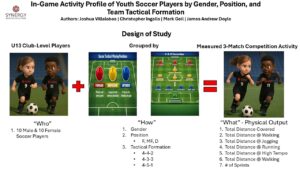
Study design illustrating how gender, position, and team tactical formation were examined in U13 club-level soccer players.
Why this matters
Before debating tactics or training models, governing bodies and Directors of Coaching must understand what was measured and under what conditions.
Study Purpose: Moving Beyond Assumptions
The purpose of this study was to investigate the influence of:
-
Gender
-
Tactical playing position (Forward, Midfielder, Defender)
-
Team tactical formation (4-4-2, 4-3-3, 4-5-1)
on in-match physical activity profiles of youth soccer players.
Participants
-
20 U13 club-level players
-
10 boys
-
10 girls
-
Measurements
Using cleat-embedded Adidas® miCoach accelerometers, we quantified:
-
Total distance covered
-
Distance at walking, jogging, running, high-tempo, and sprinting intensities
-
Total number of sprints
These methods allowed us to objectively assess how youth players actually move during competition, not just how they train.
Key Findings: What the Data Showed

Youth soccer match activity profiles vary by gender and playing position, but not by team tactical formation.
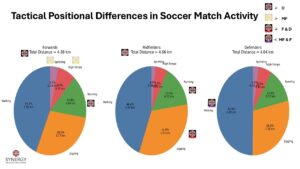
1. Playing Position Matters
Consistent with adult elite soccer literature, playing position significantly influenced match activity:
-
Midfielders covered the greatest total distance
-
Forwards performed the most high-tempo running and sprinting
-
Defenders spent a greater proportion of distance walking
These findings indicate that positional physical demands are already present at the youth level
2. Gender Differences Exist in Match Demands
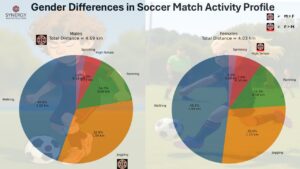
Comparison of distance distribution across movement intensities between male and female U13 players.
Key observations:
-
Boys covered greater total distance and more distance at jogging intensity
-
Girls covered a greater percentage of total distance at high-tempo intensity
These findings reinforce that training prescriptions should not be gender-neutral by default, especially during adolescence.
3. Tactical Formation Did Not Change Physical Output
Despite rotating teams through three common formations:
-
4-4-2
-
4-3-3
-
4-5-1
No significant differences were observed in match activity related to formation.
This does not mean tactics are irrelevant. Instead, it suggests that:
-
At younger ages
-
With limited tactical experience
-
And simplified positional roles
Physical output is driven more by position and player capacity than by formation alone
From Research to STRIKES™: A Systems Perspective
At Synergy, we interpret performance through a systems lens:
Performance = Readiness × Training
This study reinforces why systems—not isolated tactical choices—drive development.
STRIKES™ helps clubs evaluate:
-
Whether players are physically prepared for positional demands
-
Whether training environments reflect match realities
-
Whether tactical decisions align with player readiness

Applied coaching considerations derived from youth match-activity research.
Applied Coaching Takeaways (STRIKES™ in Action)
For Coaches and Directors of Coaching
-
Match physical preparation to playing position
Youth players adapt physiologically to the demands they are exposed to. -
Integrate position-specific training within team sessions
Conditioning should mirror competitive movement patterns. -
Be patient with positional transitions
Changing positions alters physical demands; adaptation takes time. -
Do not rely on formation alone to drive physical development
Systems and training quality matter more than shape.
These insights align directly with STRIKES™ principles of Structure, Training Environment, and Individualization
Why This Matters for Governing Bodies
For soccer federations and leagues, this research highlights the importance of:
-
Evidence-based coach education
-
Position-specific development guidelines
-
Objective performance monitoring at youth levels
Early investment in systems-driven development improves long-term player outcomes.
Why This Matters for Parents
For parents navigating youth soccer pathways:
-
Physical workload varies by position and gender
-
Development is shaped by environment, not just talent
-
Objective data protects against premature labeling
Healthy systems create more opportunity, not less.
Final Thought: Systems Before Strategy
While tactics remain essential to the modern game, this study suggests that youth development must prioritize readiness and training quality before tactical complexity.
STRIKES™ provides a framework to do exactly that—grounded in research, applied in practice, and scalable across clubs.
Learn More
📺 Watch the full STRIKES™ Applied Sport Science Channel:
👉 https://www.youtube.com/channel/UCRZkYLDVE6-SVs67jzJN7Yg
📖 Read the original research:
👉Youth-Soccer-Match-Demands-Gender-Position.pdf
⚽ Partner with Synergy Athletic Solutions:
👉 https://synergyathleticsolutions.com/