
From Participation to Prediction: Talent Identification | A Probabilistic Process
By Dr. Joshua Villalobos, PhD
Founder, Synergy Athletic Solutions
STRIKES™ Applied Sport Science
Introduction: Identification Is Not a Neutral Process
In our previous article, we examined how talent participation and detection shape who enters and remains within soccer development systems. That discussion revealed a critical reality: long before development begins, access and early filtering narrow the effective player pool.
The next stage in this sequence, talent identification is often treated as a more objective and evidence-based process. However, in practice identification remains one of the most ambiguous and consequential stages in the talent pathway.
Talent identification does not simply recognize potential.
It interprets it through systems shaped by assumptions, incentives, and uncertainty.
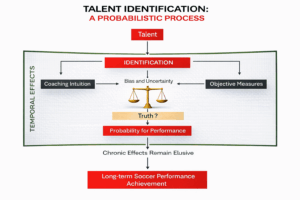
Figure 1. Talent identification in soccer conceptualized as a probabilistic process operating under temporal effects. Coaching intuition and objective measures interact within systems of bias and uncertainty, influencing short-term performance probabilities rather than guaranteeing long-term achievement.
The Blended Nature of Talent Identification
Talent identification in soccer has long relied on the subjective expertise of experienced coaches and scouts. Frameworks such as TABS (Technique, Attitude, Balance, Speed), SUPS (Speed, Understanding, Personality, Skill), and TIPS (Talent, Intelligence, Personality, Speed) reflect attempts to formalize what practitioners intuitively assess during training and competition.
These subjective evaluations should not be dismissed. Coaches and scouts develop pattern recognition through years of exposure, and their ability to interpret performance contextually remains a valuable asset within the identification process.
However, modern talent identification rarely operates on intuition alone.
Recent research supports a multidisciplinary approach, where coaches’ qualitative assessments are coupled with objective physical, physiological, and performance-based measures. When integrated thoughtfully, this combination improves the accuracy of predicting which players are more likely to progress toward professional levels.
The challenge is not choosing between subjective and objective methods but understanding how they interact within a system under uncertainty.
Physical Predictors and the Maturation Bias
Among the many factors examined in talent identification, physical and physiological characteristics have received disproportionate attention. Across numerous studies, young players whose physical outputs resemble those of older or adult professionals are more likely to be identified, promoted, and retained within club structures.
Yet this pattern reveals a fundamental limitation.
Biological maturation varies widely during adolescence. Differences in height, strength, speed, and endurance are often driven by maturation timing rather than long-term potential. As a result, identification processes frequently favor early maturing players whose current physical performance provides a temporary advantage.
This dynamic underpins the well-documented Relative Age Effect, where players born earlier in the selection year are overrepresented at youth and elite levels. The persistence of this effect across club, regional, and national teams highlights how identification systems can systematically bias selection toward maturity rather than adaptability.
When physical readiness is mistaken for developmental ceiling, identification becomes less about potential and more about timing.
Beyond Physicality: The Limits of What We Measure
Importantly, physical aptitude represents only one dimension of soccer performance.
Many talented players demonstrate advanced perceptual, tactical, and technical skills despite lagging physically during adolescence. Experienced coaches frequently note the importance of psychological profiles, game intelligence, and soccer-specific perception in differentiating high-level performers.
Yet these qualities remain difficult to quantify.
Much of the existing research relies on cross-sectional measurements of anthropometrics and physiological outputs taken at a single point in time. While informative, these approaches offer limited insight into how players adapt, compensate, and evolve across maturation and changing competitive environments.
What remains underexplored is not whether certain traits matter, but how long they persist, how they interact, and how they respond to sustained exposure to high-quality training environments.
Identification Within Already-Selected Populations
Another critical limitation of talent identification research and practice is context.
Much of what we know about predictors of success comes from players who have already been selected into professional club environments. Identification, in these cases, is occurring within a pre-filtered population shaped by earlier participation and detection constraints.
This raises an important systems-level question:
Are identification processes truly differentiating potential—or simply refining selection within an already biased pool?
Understanding talent identification requires acknowledging that it does not operate in isolation. It is nested within participation, detection, and development systems that shape who is available to be identified in the first place.
STRIKES™ Applied Sport Science Perspective
Within the STRIKES™ Applied Sport Science framework, talent identification is viewed as a probabilistic process operating under uncertainty, not a definitive verdict on future success.
Applied sport science should help organizations ask:
- What indicators are we prioritizing and why?
- How do maturation and context influence what we see?
- Are identification decisions aligned with long-term development goals?
- How do our systems support late developers and non-linear trajectories?
Identification attempts to predict.
Development determines.
But prediction without alignment increases the risk of systematic exclusion rather than optimized development.
Conclusion: Identification Is a System Constraint
Talent identification is often framed as the gateway to development. In reality, it is a constraint within the system—shaped by participation access, detection environments, maturation effects, and methodological assumptions.
Improving talent outcomes in soccer does not require perfect prediction. It requires systems that tolerate uncertainty, recognize non-linear development, and align identification decisions with long-term adaptation rather than short-term performance.
Identification does not define potential.
It reflects how a system interprets it.
Understanding that distinction is essential for any organization seeking to move from selection-driven models toward truly development-focused systems.
📺 Watch the STRIKES™ Applied Soccer Sport Science Channel:
👉 https://www.youtube.com/channel/UCRZkYLDVE6-SVs67jzJN7Yg
📥 Download the orginal research:
👉 talent-identification-soccer-probabilistic-process-applied-sport-science-villalobos.pdf
⚽ Partner with Synergy Athletic Solutions:
👉 https://synergyathleticsolutions.com/