

STRIKES Research Review: Seasonal Changes in the Physical Performance of Elite Youth Female Soccer Players
By Joshua Villalobos, PhD — Founder, Synergy Athletic Solutions
Modern soccer evolves rapidly—and the gap between sport science research and practical coaching continues to widen. STRIKES bridges that gap by turning complex research into clear, actionable insights for youth coaches, parents, and players.
STRIKES Research Article Summary
Today’s feature examines a question that matters for every club training environment:
Do youth female players get faster and more powerful as the season progresses—or can performance actually decline?
📌 
Overview of the Study
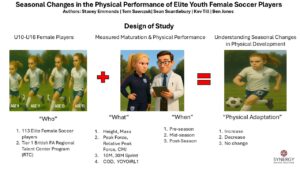
Title: Seasonal Changes in the Physical Performance of Elite Youth Female Soccer Players
Authors: Emmonds, Sawczuk, Scantlebury, Till & Jones (2020)
This study investigated season-long changes in physical performance for elite youth female players while controlling for:
-
Baseline performance, and changes in maturation status.
Who was studied?
-
113 elite U10–U16 female soccer players
-
Tier 1 British FA Regional Talent Centre (RTC) pathway
What was tested?
Key measures included strength/power and on-field physical qualities:
-
Peak force & relative peak force
-
Countermovement jump (CMJ)
-
10m & 30m sprint
-
Change of direction (COD)
-
Yo-Yo IR1 distance
When were players tested?
-
Pre-season
-
Mid-season
-
Post-season
⭐ Key Findings
📌 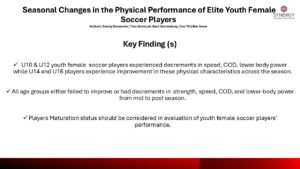
1. U10 & U12 players showed decrements across the season
Younger players experienced declines in:
-
Speed
-
COD
-
Lower-body power
-
U14 & U16 improved earlier—but mid-to-post season was a problem for everyone 2. Mid-season to post-season, all age groups either failed to improve or showed decrements in:
-
Strength
-
Speed
-
COD
-
Lower-body power
3. Maturation status must be considered
-
Maturation influences performance trends—so player evaluation should not rely on chronological age alone
Seasonal Performance Changes (Data Snapshot)
📌 
This table helps visualize how physical characteristics shift from pre- to mid- to post-season across age groups. The key message: mid-to-late season can be a risk window for stagnation or decline, especially if training stimulus and recovery aren’t managed well.
Applied Coaching Perspective: Why Might Performance Decline In-Season?
A few practical questions follow naturally from these findings:
Are most in-season sessions primarily technical and tactical, with limited speed/strength stimulus?
-
Are players experiencing fatigue accumulation, or is it a lack of training stimulus—or both?
-
Are you using any form of load monitoring to guide training adjustments?
📌

Coaching takeaway:
If performance drops from mid- to post-season, it may signal the need for better load management, better stimulus selection, or a smarter blend of both.
What Coaches Should Take Away
-
Player development isn’t linear—season timing matters
-
Small-sided games can be used more intentionally to support physical outcomes
-
Consider supplemental soccer fitness that fits inside your periodization plan
-
Build systems for routine performance testing and load monitoring, even in youth settings
STRIKES Takeaway
Youth soccer development isn’t linear—and in-season physical progress isn’t guaranteed. This research reminds us that maintaining speed, strength, and power across a long season requires intentional planning, monitoring, and appropriate stimulus.
Stay tuned for more STRIKES Research Reviews as we continue translating soccer science into practical insights for everyone in the game.
Follow Synergy Athletic Solutions on Instagram & YouTube
Visit our website blog for more insights, research, and applied sport science content
Reach out directly to collaborate or inquire about training services
Reference
📌 
Emmonds, S., Sawczuk, T., Scantlebury, S., Till, K., & Jones, B. (2020). Seasonal Changes in the Physical Performance of Elite Youth Female Soccer Players. Journal of Strength and Conditioning Research, 34(9), 2636–2643. https://doi.org/10.1519/JSC.0000000000002943