
From Competition Level to Talent Development: Why Systems Shape Soccer Outcomes
By Dr. Joshua Villalobos, PhD
Founder, Synergy Athletic Solutions
Introduction: Building on the Training Environment Conversation
In our previous article, Team Competition Level and Soccer Training Environments, we explored how competition level does more than influence match outcomes—it defines the daily training stimulus players adapt to over time.
That discussion raised a broader and more fundamental question:
If training environments shape adaptation, how do those environments interact with the way we define, identify, and develop talent in soccer?
To answer this, we must move beyond isolated training variables and examine the systems that govern talent development across a player’s career.
Talent Is Not a Trait—It Is a Process
In soccer, talent is often treated as a fixed attribute—something players either possess or lack. This belief continues to drive early identification, selection, and advancement decisions across development pathways.
However, research and applied practice suggest a more accurate framing:
talent is temporal, context-dependent, and continuously shaped by environment.
Talent expression evolves as players move through systems of detection, identification, development, and selection. Performance at any given moment reflects the interaction between the player and their current environment—not a final measure of potential.
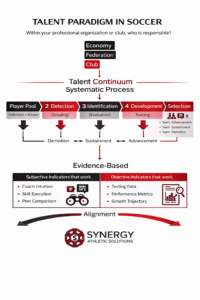
The Talent Paradigm in Soccer
Across a footballer’s career, talent progresses through five interconnected stages:
- Player Pool – Unknown and known participants with varying access and opportunity
- Detection – Scouting processes that identify potential prospects
- Identification – Evaluation aimed at predicting suitability for higher levels
- Development – Training environments designed to cultivate athletic potential
- Selection – Decisions related to advancement, sustainment, or demotion
While interconnected, these stages serve different purposes. Detection and identification attempt to predict future performance. Development, however, is the stage where long-term adaptation actually occurs.
This distinction is critical.
Why Competition Level Still Matters
As discussed in our previous post, team competition level shapes training environments through:
-
Coaching behaviors
-
Tactical demands
-
Task constraints
-
Decision-making density
-
Physical and cognitive load
These factors define what players adapt to on a daily basis. When competition level increases without intentional alignment of training design, players may experience accelerated selection rather than enhanced development.
Higher levels do not inherently produce better players.
Better-designed environments do.
Selection vs Development: A Persistent Misalignment
Many soccer systems are highly efficient at selection. Players who adapt quickly to existing constraints are promoted, while others are filtered out.
The risk is not selection itself—it is mistaking selection efficiency for developmental effectiveness.
When systems overemphasize early identification and advancement, they often confuse current performance with future potential. This can limit the development of players whose trajectories are nonlinear or environment-sensitive.
True development requires environments that support learning, adaptation, and progression—not just performance under pressure.
An Applied Sport Science Perspective
Within the STRIKES™ Applied Sport Science framework, talent development is viewed as an environment design and alignment challenge, not a prediction problem.
Data and evaluation tools are valuable only when they inform decisions about:
-
Training quality
-
Constraint manipulation
-
Competition exposure
-
Alignment between development stages
Applied sport science should help organizations understand what players are adapting to, not just how they perform.
When environments are aligned across competition level, training design, and development objectives, player progression becomes intentional rather than accidental.
Conclusion: Systems Drive Outcomes
Talent development in soccer does not occur in isolation. It emerges from the interaction between players and the environments they experience across time and competition levels.
Our previous discussion on team competition level highlighted how environments shape adaptation. This article extends that conversation by emphasizing how those environments intersect with talent paradigms and development systems.
The challenge facing modern soccer is not identifying talent earlier—it is designing aligned systems that allow talent to evolve over time.
Better alignment creates better environments.
Better environments create better players.
📺 Watch the STRIKES™ Applied Soccer Sport Science Channel:
👉 https://www.youtube.com/channel/UCRZkYLDVE6-SVs67jzJN7Yg
📥 Download the orginal research:
👉 The Talent Paradigm in Soccer: An Applied Sport Science Perspective on Player Development
⚽ Partner with Synergy Athletic Solutions:
👉 https://synergyathleticsolutions.com/