
Soccer Training and the Ecology of Player Development: Why Small-Sided Games Matter in Modern Talent Systems
By Dr. Joshua Villalobos, PhD
Founder, Synergy Athletic Solutions
STRIKES™ Applied Sport Science
Introduction: Training Is the Environment Where Development Occurs
In previous STRIKES™ Applied Sport Science discussions, we examined how participation, identification, and selection shape access to soccer development pathways. Selection determines who enters high-performance environments.
Training determines what happens once they arrive.
Professional soccer development systems rely on integrated expertise across multiple disciplines, including coaching, strength and conditioning, sport medicine, sport psychology, and individual skill development. Each contributes to player progression, but the most influential environment for daily adaptation remains coach-led field training.
This is where players repeatedly interact with the constraints of the game.
How training is designed ultimately determines whether a development environment reinforces short-term performance or cultivates long-term adaptability.
Among the many tools used in modern soccer training, small-sided games (SSGs) have become one of the most widely implemented methods for preparing players for match competition.
Understanding why these training structures are effective provides insight into how development environments shape talent over time.
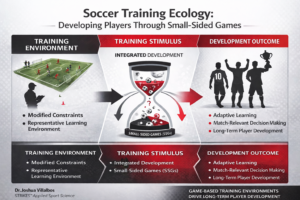
Figure 1. Soccer Training Ecology Model. Small-sided games create representative training environments that generate integrated technical, tactical, and physical development in soccer players.[/caption]
Why Coaches Rely on Small-Sided Games
Small-sided games are modified versions of match play involving fewer players, reduced field dimensions, and targeted tactical constraints. They are often referred to as game-based training or skill-based games.
Across professional clubs and elite academies, SSGs are commonly used because they reproduce many of the core demands of match competition.
Research suggests these training formats effectively replicate several important characteristics of the game, including:
- Movement patterns and spatial interactions
- Physiological intensity
- Technical skill execution
- Tactical decision-making under pressure
Because these elements occur simultaneously, SSGs provide an integrated training stimulus that isolated drills cannot easily replicate (Hill-Haas et al., 2011; Gabbett & Mulvey, 2008).
Players are not simply rehearsing skills.
They are solving problems.
Each moment in an SSG requires players to perceive environmental information, interpret tactical context, and execute technical actions while under physical and psychological pressure. This interaction between perception, decision-making, and movement is central to real match performance.
In this sense, small-sided games function as representative learning environments, allowing players to practice within constraints that closely resemble competitive play.
Training Intensity and Ecological Validity
Another reason coaches rely heavily on SSGs is their ability to produce high physiological training loads while maintaining tactical relevance.
During small-sided games, players experience:
- Frequent accelerations and decelerations
- Repeated high-intensity efforts
- Continuous involvement in play
- Increased ball contacts and decision opportunities
Compared to full-field training scenarios, the reduced player numbers often increase each individual’s engagement with the game.
This increased involvement means players accumulate:
- More technical repetitions
- More tactical decisions
- More physically demanding movements
All within a single training activity.
From an applied sport science perspective, SSGs represent a training structure that simultaneously stimulates technical, tactical, and physiological adaptation.
This integration is why they have become a central component of training methodology across professional soccer environments.
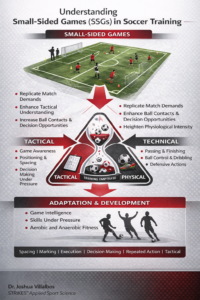
Figure 2. Training Impulse Generated by Small-Sided Games. SSGs simultaneously stimulate tactical awareness, technical execution, and physical demands, creating integrated adaptation in soccer players.[/caption]
The Role of Training Sessions in Talent Evaluation
Training sessions serve another important function beyond skill development.
They are also where talent evaluations occur daily.
Coaches observe players’ behaviors within these training environments, forming judgments about performance, potential, and readiness for higher levels of competition.
However, evaluating talent within training contexts presents several challenges.
Player performance during small-sided games can be influenced by numerous interacting factors, including:
- Current fatigue levels
- Tactical understanding
- Team dynamics
- Confidence and psychological state
- Biological maturation
- Prior training exposure
As a result, performance observed during training does not always represent stable indicators of long-term potential.
This reinforces a key point emphasized in previous STRIKES™ discussions:
Observed performance is context-dependent.
What coaches see in a training session reflects an interaction between player ability and environmental constraints.
Understanding those constraints is essential when interpreting performance.
Training Design Shapes Development
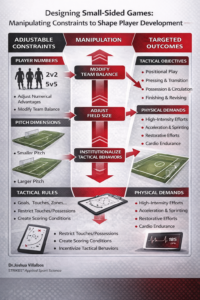
Figure 3. Designing Small-Sided Games. Coaches manipulate constraints such as player numbers, pitch size, and tactical rules to influence tactical behavior and physical intensity in soccer training.[/caption]
Because training environments influence both performance and evaluation, the design of those environments carries significant consequences.
Coaches control several key variables within small-sided games, including:
- Number of players
- Field dimensions
- Rules and constraints
- Tactical objectives
- Work-to-rest ratios
Each modification alters the demands placed on players.
For example:
Reducing field size may increase technical pressure and quick decision-making.
Increasing player numbers may emphasize tactical structure and positioning.
Manipulating rules may prioritize specific behaviors such as pressing, transition play, or ball circulation.
In this way, training design acts as a developmental filter.
The structure of the game determines which player attributes are expressed, reinforced, or suppressed during practice.
Over time, these repeated constraints shape the types of players that development systems produce.
The Need for Continued Research
Although small-sided games are widely used, important questions remain regarding how different training configurations influence long-term player development.
Research is still needed to better understand:
- How specific SSG designs influence tactical learning
- How training constraints affect decision-making development
- How different player profiles respond to game-based training environments
- How training performance relates to long-term progression in competitive soccer
Additionally, because training sessions are often used as contexts for talent evaluation, understanding how players respond to these environments is critical for improving development systems.
Better knowledge of training responses can help organizations distinguish between temporary performance fluctuations and meaningful developmental signals.
STRIKES™ Applied Sport Science Perspective
Within the STRIKES™ Applied Sport Science framework, training environments are not simply preparation tools for competition.
They are development systems in miniature.
Each training session reflects the priorities of the organization designing it.
Small-sided games illustrate this principle clearly.
When designed thoughtfully, they provide rich environments that challenge perception, movement, decision-making, and tactical understanding simultaneously. These environments support adaptive learning and reinforce the complex interactions that define real match play.
However, when training structures prioritize narrow outcomes such as immediate tactical compliance or short-term performance, they may unintentionally constrain creative and adaptive player behaviors.
The goal of applied sport science is not to prescribe a single training model.
It is to help organizations understand how training design interacts with development objectives.
Training environments should be intentionally aligned with long-term player development goals rather than simply replicating competition demands.
Conclusion: Development Happens in the Training Environment
Selection decisions determine which players gain access to high-performance environments.
Training determines what those players become.
Small-sided games have become central to soccer training because they recreate the complex demands of competition while providing a flexible platform for learning and adaptation. They allow players to develop technical execution, tactical awareness, and physical capacity within representative game contexts.
However, the effectiveness of these environments depends on how they are designed and interpreted.
Training sessions are not neutral spaces.
They shape development, influence evaluation, and ultimately affect the trajectory of players within soccer systems.
Understanding the relationship between training design, player behavior, and long-term development remains one of the most important challenges for modern soccer science.
Improving player development does not begin with better selection tools alone.
It begins with better environments.
And in soccer, those environments are built on the training field.
📺 Explore more STRIKES™ Applied Soccer Sport Science content
👉 https://www.youtube.com/channel/UCRZkYLDVE6-SVs67jzJN7Yg
📥 Download the original research
👉Small-Sided Games in Soccer Training: Sport Science Insights for Player Development Villalobos
⚽ Partner with Synergy Athletic Solutions
👉 https://synergyathleticsolutions.com/