
From Competition Level to Talent Development: Why Systems Shape Soccer Outcomes
By Dr. Joshua Villalobos, PhD
Founder, Synergy Athletic Solutions
STRIKES™ Applied Sport Science
Talent Participation and Detection in Soccer: Why the Player Pool Is Smaller Than We Think
Introduction: Extending the Talent Paradigm Conversation
In our previous articles, we explored how team competition level and training environments shape long-term player adaptation, and how talent development unfolds across interconnected stages rather than isolated decisions.
That discussion naturally raises another critical question:
Before talent can be identified, developed, or selected,
who is actually participating in the system in the first place?
To understand talent outcomes in soccer, we must first examine talent participation and detection, and how structural constraints narrow the player pool long before development truly begins.
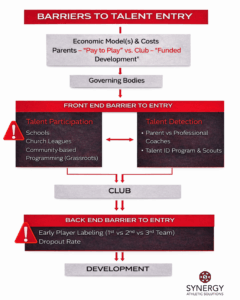
Figure 1. System-level barriers to talent entry in soccer, highlighting how economic models, governance, participation pathways, and early selection shape long-term development outcomes.
The Expanding Game and the Constrained Player Pool
Global investment and participation in soccer have increased exponentially. Professional clubs now operate highly structured youth-to-senior development pathways, with thousands of young male and female players engaged worldwide.
Yet increased participation does not necessarily translate to a broader or more equitable talent pool.
Socioeconomic constraints, access to training environments, and early exposure to high-level competition continue to shape who enters—and remains within organized soccer development systems.
For many players, the pathway narrows early.
Early Attrition and the Cost of Rejection
One often overlooked factor in talent participation is the psychosocial impact of early rejection. Trial periods, early deselection, and competitive filtering can lead to:
- Reduced perceived competence
- Withdrawal from structured development
- Loss of late-developing or environment-sensitive players
These effects are not always performance-based. They are frequently driven by system design rather than player capacity.
As a result, the effective talent pool becomes progressively smaller. Not because potential disappears, but because opportunity does.
Talent Detection Within Club Structures
Within professional club environments, talent detection is rarely an open process.
Instead, it is largely constrained to:
- A club’s internal player pool
- External competitive opponents within the same ecosystem
Detection therefore becomes less about discovering unknown potential and more about filtering within already restricted populations.
As players train and compete, detection transitions into identification and recruitment—often led by experienced coaches, supported by sport science staff, and informed by perceived predictors of future performance.
Predictors, Indicators, and Uncertainty
Across sport science disciplines, numerous potential predictors and mediators of high-level soccer performance have been proposed—spanning physical, physiological, technical, tactical, psychological, and sociological domains.
Some indicators demonstrate empirical support across adolescence into adulthood. Many do not.
This uncertainty presents a challenge.
When detection and identification rely heavily on early indicators, systems risk overvaluing short-term performance signals while underestimating the role of environment, maturation, and adaptation over time.
More research is needed to understand how current recruitment trends interact with long-term development trajectories.
Detection Is Not Development
A critical distinction must be reinforced:
Detection identifies who is present.
Development determines who progresses.
Detection and identification are predictive processes operating under uncertainty. Development, by contrast, is shaped by training quality, competition exposure, and alignment across the system.
When detection is treated as a proxy for development, early selection pressure increases, often at the expense of long-term potential.
STRIKES™ Applied Sport Science Perspective
Within the STRIKES™ Applied Sport Science framework, talent participation and detection are viewed as system-level constraints, not neutral starting points.
Applied sport science should help organizations ask:
- Who has access to development environments?
- What factors limit entry and retention?
- How do early decisions influence downstream outcomes?
- Are detection processes aligned with long-term development goals?
Without addressing participation and detection, even the most well-designed training environments operate on a narrowed and biased player pool.
Conclusion: Development Begins Before Development
Talent outcomes in soccer are shaped long before players reach advanced stages of identification, development, or selection.
Participation, access, and detection act as gatekeepers within the system, determining who gets the opportunity to develop in the first place.
Understanding and refining these early stages is essential if soccer organizations wish to move from selection-driven models toward truly development-focused systems.
Talent does not begin at identification.
It begins with who is allowed to participate and remain within the system.
📺 Watch the STRIKES™ Applied Soccer Sport Science Channel:
👉 https://www.youtube.com/channel/UCRZkYLDVE6-SVs67jzJN7Yg
📥 Download the orginal research:
👉 Talent Participation and Detection in Soccer: An Applied Sport Science Perspective
⚽ Partner with Synergy Athletic Solutions:
👉 https://synergyathleticsolutions.com/