
STRIKES™: Why Systems—Not Size—Develop Elite Youth Soccer Players
By Dr. Joshua Villalobos, PhD
Founder, Synergy Athletic Solutions
Youth soccer organizations face a fundamental challenge:
How do we develop players for the next level without relying on subjective selection or early physical maturity?
At Synergy Athletic Solutions, we believe the answer lies not in isolated drills, single tryouts, or body size—but in systems.
Our recent research examining physical differences between elite and competitive U14 female soccer players provides objective evidence to support this position and forms the scientific foundation of STRIKES™, a systems-based development methodology.
The Research Question Governing Bodies and Clubs Must Ask
Youth soccer systems often assume elite players are identified because they are:
- Bigger
- More physically mature
- “Naturally” superior athletes
Our research directly tested that assumption.
Study Overview
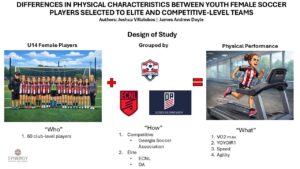
Who
- 60 U14 female club-level players
How
- Grouped by pathway:
- Elite: ECNL & Development Academy
- Competitive: State-level clubs
What
- Laboratory testing: VO₂max, DEXA
- Field testing: Yo-Yo IR1, sprint speed, agility
What the Data Actually Showed
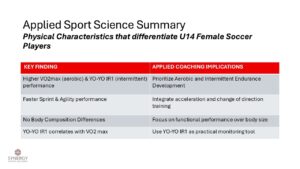
- Elite Players Were More Physically Prepared
Elite players demonstrated:
- Higher absolute and relative VO₂max
- Greater Yo-Yo IR1 distance
- Faster sprint speed
- Superior agility performance
These qualities align directly with the physiological demands of elite match play.
- Body Composition Did Not Differentiate Competitive Level
Critically, no differences were observed between elite and competitive players in:
- Body fat percentage
- Lean mass
- Bone mineral content
This challenges long-standing assumptions in youth soccer selection.
Performance readiness—not body size—distinguished elite players.
- Yo-Yo IR1 Is a Practical, Scalable Monitoring Tool
Across all players, Yo-Yo IR1 performance correlated with VO₂max, supporting its validity as a field-based indicator of aerobic fitness.
For clubs and federations, this matters:
- Low cost
- Easy to standardize
- Scalable across environments
From Findings to Framework: Why STRIKES™ Exists
The research explains what differed between players.
STRIKES™ explains why those differences emerge across environments.
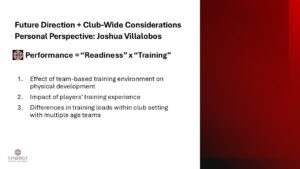
At Synergy, we use a simple applied principle:
Performance = Readiness × Training
STRIKES™ operationalizes this equation at the system level.
Introducing STRIKES™
The Synergy Athletic Solutions Systems Methodology
STRIKES™ represents the seven system variables that shape long-term player development:
- S — Structure
- T — Training Environment
- R — Resources
- I — Individualization
- K — Knowledge Integration
- E — Exposure
- S — Support Systems
Elite performance is not inherited — it is built inside systems.
What This Means for Soccer Governing Bodies
This research highlights the need to:
- Standardize objective readiness indicators
- Reduce bias in selection processes
- Align development pathways across clubs
- Support coach education with applied sport science
STRIKES™ provides a shared systems language.
What This Means for Directors of Coaching
STRIKES™ helps Directors of Coaching:
- Evaluate training environments
- Protect late-developing players
- Align teams across age groups
- Support long-term athlete development
What This Means for Parents
For parents navigating youth soccer pathways:
- Size ≠ readiness
- Environment matters
- Data protects opportunity
Healthy systems create better outcomes for more players.
Applied Sport Science Summary
Key Findings
- Higher VO₂max & Yo-Yo IR1 differentiate elite players
- Speed and agility matter early
- Body composition does not predict competitive level
Applied Implications
- Train aerobic & intermittent endurance
- Prioritize acceleration & change of direction
- Use Yo-Yo IR1 as a monitoring tool
- Build systems—not shortcuts
Moving Forward: From Selection to Development
The future of youth soccer requires a shift:
From identifying players → to developing environments
STRIKES™ provide structure to make that shift measurable and sustainable.
Learn More
📺 Watch the STRIKES™ Applied Soccer Sport Science Channel:
👉 https://www.youtube.com/channel/UCRZkYLDVE6-SVs67jzJN7Yg
📥 Download the research:
👉 Elite-vs-Competitive-Youth-Female-Soccer-Performance-Joshua Villalobos Research Manscript.pdf
⚽ Partner with Synergy Athletic Solutions:
👉 https://synergyathleticsolutions.com/