

STRIKES Research Review: What U15 Performance Tells Us About Future Success in Female Soccer
By Joshua Villalobos PhD — Founder, Synergy Athletic Solutions
Modern soccer evolves rapidly—and the gap between sport science research and practical coaching continues to widen. STRIKES bridges that gap by turning complex research into clear, actionable insights for youth coaches, parents, and players.
Today’s feature examines one of the most influential areas of soccer development:
How accurately can U15 performance predict future success in elite female soccer players?
This research—conducted within the German Football Federation pathway—provides powerful takeaways for U.S. youth soccer systems, talent identification, and player development models.
Overview of the Study
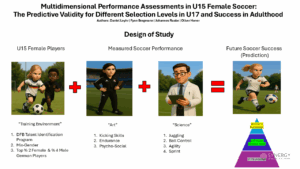
Title: Multidimensional Performance Assessments in U15 Female Soccer: Predictive Validity for U17 and Adult Success
Authors: Leyhr, Bergmann, Raabe & Höner (2025)
The research followed elite female players from Germany’s DFB Talent Identification Program, where:
- Athletes represent the top 2% of female players nationally
- They train in mixed-gender environments
- Players are evaluated using both subjective and objective measures
These evaluations were compared to future outcomes in:
- U17 Bundesliga
- U17 German Youth National Team
- Women’s Professional Bundesliga
Data Collected: “Art” + “Science”
Subjective Coach Evaluations (“Art”)
- Kicking Technique
- Endurance
- Psycho-Social Skills
- Tactical Understanding
Objective Performance Metrics (“Science”)
- Sprint Performance
- Change of Direction (Agility/CODS)
- Ball Control
- Juggling Ability
This blended methodology is critical—because neither subjective nor objective assessment alone is sufficient for predicting long-term success.

⭐ Key Findings
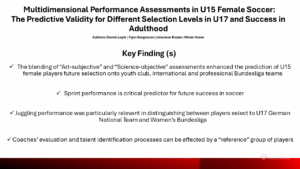
- Combining Subjective and Objective Data Improves Prediction Accuracy
The strongest developmental insights came from blending:
Coach intuition + standardized performance testing
This combination significantly improved predictions for future Bundesliga and national team selection.
- Sprint Speed Is the Strongest Predictor at Age 15
Across all future competition levels, linear sprint ability was the most reliable performance indicator.
If you’re a coach designing training plans, speed development must remain a year-round priority.
- Juggling Ability Predicts High-Level Technical Success
Players selected for the:
- U17 German Youth National Team, and
- Women’s Bundesliga
…showed dramatically superior juggling performance at age 15.
This reinforces the value of:
- Technical mastery
- Ball-manipulation proficiency
- Foot-eye coordination
- Coach Bias Exists—Reference Groups Matter
Coaches evaluating female players who train with elite male players showed different rating tendencies.
This highlights the need for:
- Standardized evaluation rubrics
- Coach education
- Awareness of comparison-based bias
Why This Matters for U.S. Youth Soccer
A critical difference between systems:
Germany uses mixed-gender training through U15
The U.S. separates players by gender as early as U8
This raises essential development questions:
- Does early separation limit challenge?
- Does mixed-gender training create better technical and tactical environments?
- How does this influence talent identification?
These questions must be examined more closely in the American system.
What Coaches Should Take Away
- Speed and tactical understanding are elite-level predictors
- Ball mastery & juggling remain vital developmental tools
- Talent identification must be multi-dimensional
- Evaluation systems require structure and consistency
- Art + Science provides the clearest picture of potential
STRIKES Takeaway
Youth soccer development isn’t linear. Potential isn’t fixed at 15. But research like this helps coaches build better environments and make more informed decisions.
Stay tuned for more STRIKES Research Reviews as we continue translating soccer science into practical insights for everyone in the game.
📱 Follow Synergy Athletic Solutions on Instagram & YouTube
📝 Visit our website blog for more insights, research, and applied sport science content
📩 Reach out directly to collaborate or inquire about training services