
Advancing Youth Soccer Development Through Applied Sport Science
A Comprehensive Analysis of Synergy Athletic Solutions’ In-Season Performance Program
By Joshua Villalobos, PhD – Founder, Synergy Athletic Solutions
Youth soccer continues to evolve at an extraordinary pace. Players today are expected to be faster, more resilient, more tactically aware, and more athletically intelligent than ever before. To meet these rising demands, Synergy Athletic Solutions partnered with SSA Swarm FC to implement a 12-week In-Season Sport Science Program—a structured, evidence-based approach designed to enhance physical performance while prioritizing player health and long-term development.
This report integrates all program components, physical performance profiles, and complete test results across acceleration, speed, agility, sprint endurance, and power. The goal: to provide players, parents, and coaches with clear, objective insight into how athletes develop and respond to training.
Program Benefits: Why Sport Science Matters
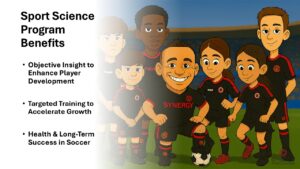
The integration of sport science into youth soccer environments delivers three core benefits:
- Objective Insight
Data provides clarity—highlighting strengths, exposing limitations, and guiding targeted development.
- Targeted, Efficient Training
The program tailors supplemental training to the specific physical demands athletes face during the season.
- Long-Term Health & Durability
Monitoring enables smarter load management, reducing injury risk and supporting sustainable athletic growth.
Program Structure

The 12-week program followed a systematic performance model:
- Baseline Testing
- Weekly Soccer-Specific Supplemental Training
- Post-Training Performance Testing
This approach ensured progress was measured—not assumed.
Understanding the Soccer Physical Performance Profile
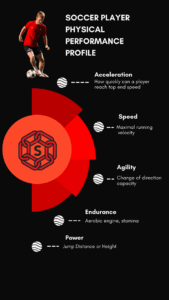
A soccer player’s physical profile consists of five interdependent qualities:
- Acceleration – ability to rapidly generate speed
- Speed – maximal sprinting velocity
- Agility – efficiency of directional changes
- Endurance – repeatability of high-intensity efforts
- Power – explosiveness in jumping, tackling, and striking
Each quality directly influences technical execution and tactical decision-making during match play.
Important Performance Considerations
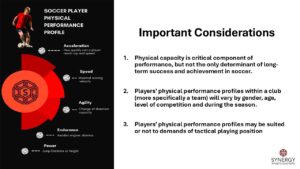
Performance data must always be interpreted in context. Key considerations include:
- Physical capacity matters—but does not solely determine soccer success.
- Profiles naturally vary by age, gender, maturity, competition level, and phase of season.
- Certain physical traits align better with specific match roles, which is essential for individualized development.
Step 1: Evaluate Team and Individual Context
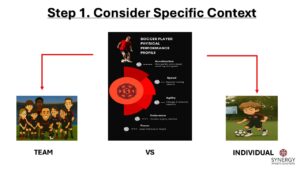
To gain a complete understanding of development:
- Team averages show collective progress
- Individual profiles identify unique adaptation patterns
Both perspectives are essential to responsible sport science application.
Step 2: Interpreting the Metrics
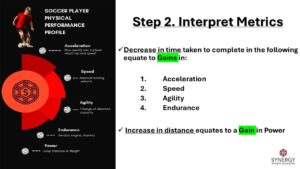
Interpreting the results is straightforward:
- Decreases in time indicate improvements in acceleration, speed, agility, and endurance
- Increases in distance indicate improvements in power
This consistency ensures accurate and objective evaluation.
Acceleration Performance
Team Acceleration
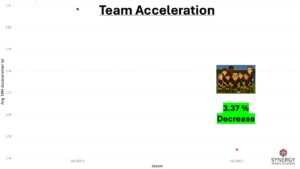
The team achieved a 3.37% improvement in 10-meter acceleration, reflecting enhanced explosiveness and early-phase sprint ability.
Individual Acceleration
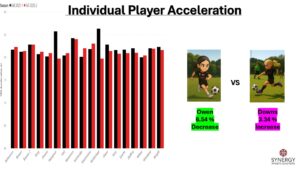
Key individual outcomes included:
- Owen: 6.54% improvement
- Downs: 3.34% decrease
This variability is normal and highlights individual training responsiveness.
Speed Performance
Team Speed
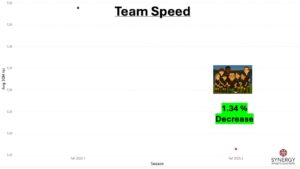
Team sprint speed improved by 1.34%, demonstrating increased efficiency in reaching and sustaining top-end velocity.
Individual Speed
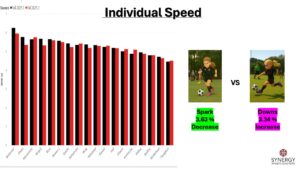
Individual results showed diverse adaptation:
- Sparks: 3.63% improvement
- Downs: 3.34% decrease
Such differences underscore the importance of tailored training strategies.
Agility Performance
Team Agility
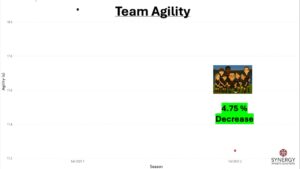
The team recorded a 4.75% improvement in agility test time—an important indicator of change-of-direction efficiency.
Individual Agility

Notable individual outcomes:
- McMichael: 9.01% improvement
- Downs: 6.16% improvement
These gains translate into improved defensive maneuvering, dribbling control, and movement efficiency.
Sprint Endurance Performance
Team Sprint Endurance

Team average time on the 300-yard test improved by 4.81%, reflecting better fatigue resistance during repeated high-intensity efforts.
Individual Sprint Endurance
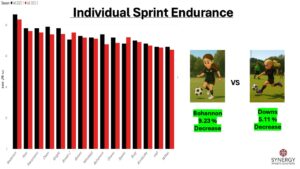
Individual adaptation examples:
- Bohannon: 9.23% improvement
- Downs: 5.11% improvement
These gains support improved performance deep into matches and during congested schedules.
Power Performance
Team Power
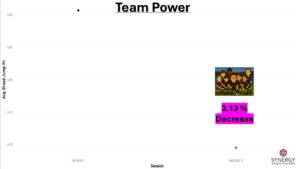
The team displayed a 3.13% improvement in broad jump performance, indicating enhanced explosive power.
Individual Power
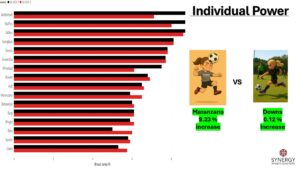
Key individual findings:
- Maranzano: 9.23% improvement
- Downs: 0.12% improvement
Explosive power contributes to stronger tackles, more forceful striking, and greater aerial dominance.
Applying These Results to Match Play
The improvements documented across acceleration, speed, agility, endurance, and power translate into real match advantages:
- Faster separation from defenders
- More effective defensive recovery
- Better directional control in tight spaces
- Greater fatigue resistance
- Higher-quality striking and aerial play
Athletes who develop these qualities become more adaptable, more confident, and more competitive.
Conclusion
The Synergy Athletic Solutions In-Season Sport Science Program demonstrates the meaningful impact of applying objective, evidence-based development models to youth soccer environments. The results highlight not only measurable progress but also a broader cultural shift toward smarter, data-informed training.
As the physical demands of the game continue to rise, our commitment remains the same:
to help every athlete train intelligently, compete confidently, and develop sustainably.
📱 Follow Synergy Athletic Solutions on Instagram & YouTube
📝 Visit our website blog for more insights, research, and applied sport science content
📩 Reach out directly to collaborate or inquire about training services